| ⇦ | 
| ⇨ |
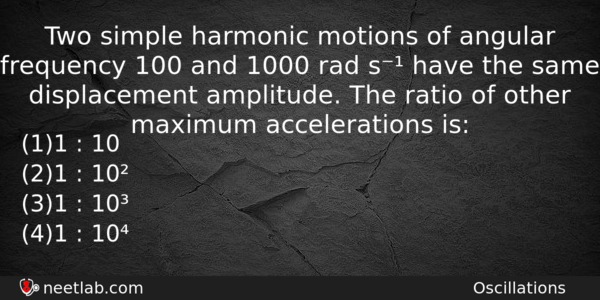
Two simple harmonic motions of angular frequency 100 and 1000 rad s⁻¹ have the same displacement amplitude. The ratio of other maximum accelerations is:
Options
(a) 1 : 10
(b) 1 : 10²
(c) 1 : 10³
(d) 1 : 10⁴
Correct Answer:
1 : 10²
Explanation:
Maximum acceleration of a particle in the simple harmonic motion is directly proportional to the square of angular frequency i.e., a(max)= – w ² A
As A remains same, we can say
a₁ / a₂ = w₁² / w₂² = (100)² / (1000)² = 1 / 100
⇒ a₁ : a₂ = 1 : 10²
Related Questions: - A bucket full of water is revolved in a vertical circle of 2m
- ln a surrounding medium of temperature 10⁰C a body takes 7 min for a fall
- A simple pendulum oscillates in a vertical plane. When it passes through the mean
- A wire of a certain material is stretched slowly by ten percent. Its new resistance
- For an ideal gas of diatomic molecules
Topics: Oscillations
(58)
Subject: Physics
(2479)
Important MCQs Based on Medical Entrance Examinations To Improve Your NEET Score
- A bucket full of water is revolved in a vertical circle of 2m
- ln a surrounding medium of temperature 10⁰C a body takes 7 min for a fall
- A simple pendulum oscillates in a vertical plane. When it passes through the mean
- A wire of a certain material is stretched slowly by ten percent. Its new resistance
- For an ideal gas of diatomic molecules
Topics: Oscillations (58)
Subject: Physics (2479)
Important MCQs Based on Medical Entrance Examinations To Improve Your NEET Score
18000+ students are using NEETLab to improve their score. What about you?
Solve Previous Year MCQs, Mock Tests, Topicwise Practice Tests, Identify Weak Topics, Formula Flash cards and much more is available in NEETLab Android App to improve your NEET score.

Share this page with your friends
Leave a Reply