| ⇦ | 
| ⇨ |
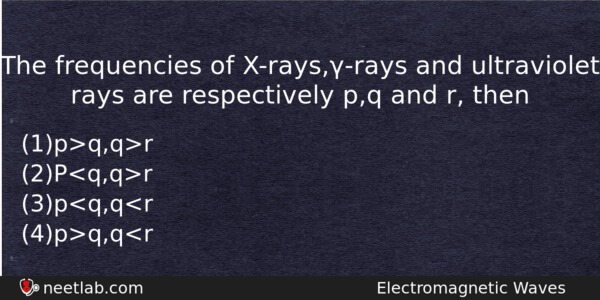
The frequencies of X-rays,γ-rays and ultraviolet rays are respectively p,q and r, then
Options
(a) p greater than q,q greater than r
(b) p less than q,q greater than r
(c) p less than q,q less than r
(d) p greater than q,q less than r
Correct Answer:
p less than q,q greater than r
Explanation:
No explanation available. Be the first to write the explanation for this question by commenting below.
Related Questions: - The string of a pendulum is horizontal.The mass of bob attached to it is m
- λ₁ and λ₂ are used to illuminate the slits. β₁ and β₂ are the corresponding fringe
- Two equal and opposite charges of masses m₁ and m₂ are accelerated
- A wire is suspended vertically from one of its ends is stretched by attaching a weight
- Which of the following physical quantities has neither dimensions nor unit
Topics: Electromagnetic Waves
(28)
Subject: Physics
(2479)
Important MCQs Based on Medical Entrance Examinations To Improve Your NEET Score
- The string of a pendulum is horizontal.The mass of bob attached to it is m
- λ₁ and λ₂ are used to illuminate the slits. β₁ and β₂ are the corresponding fringe
- Two equal and opposite charges of masses m₁ and m₂ are accelerated
- A wire is suspended vertically from one of its ends is stretched by attaching a weight
- Which of the following physical quantities has neither dimensions nor unit
Topics: Electromagnetic Waves (28)
Subject: Physics (2479)
Important MCQs Based on Medical Entrance Examinations To Improve Your NEET Score
18000+ students are using NEETLab to improve their score. What about you?
Solve Previous Year MCQs, Mock Tests, Topicwise Practice Tests, Identify Weak Topics, Formula Flash cards and much more is available in NEETLab Android App to improve your NEET score.

Share this page with your friends
frequency of uv rays(r)=10^16 Hz to 10^17 Hz
frequency of x-rays(p)=10^18 Hz to 10^20 Hz
frequency of gamma-rays(q)=10^18 Hz to 10^22 Hz
therefore, p is less than q and q is greater than r.