| ⇦ | 
| ⇨ |
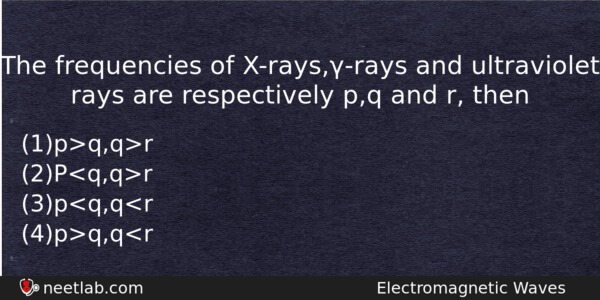
The frequencies of X-rays,γ-rays and ultraviolet rays are respectively p,q and r, then
Options
(a) p greater than q,q greater than r
(b) p less than q,q greater than r
(c) p less than q,q less than r
(d) p greater than q,q less than r
Correct Answer:
p less than q,q greater than r
Explanation:
No explanation available. Be the first to write the explanation for this question by commenting below.
Related Questions: - A police jeep is chasing a culprit going on a motorbike.The motorbike crosses
- A body of mass 1 kg is thrown upwards with a velocity 20 m/s. It momentarily
- Monochromatic light of wavelength 667 nm is produced by a helium neon laser
- A closely wound solenoid of 2000 turns and area of cross-section 1.5 x 10⁻⁴ m² carries
- A moving neutron collides with a stationary α-particle.The fraction of the kinetic energy
Topics: Electromagnetic Waves
(28)
Subject: Physics
(2479)
Important MCQs Based on Medical Entrance Examinations To Improve Your NEET Score
- A police jeep is chasing a culprit going on a motorbike.The motorbike crosses
- A body of mass 1 kg is thrown upwards with a velocity 20 m/s. It momentarily
- Monochromatic light of wavelength 667 nm is produced by a helium neon laser
- A closely wound solenoid of 2000 turns and area of cross-section 1.5 x 10⁻⁴ m² carries
- A moving neutron collides with a stationary α-particle.The fraction of the kinetic energy
Topics: Electromagnetic Waves (28)
Subject: Physics (2479)
Important MCQs Based on Medical Entrance Examinations To Improve Your NEET Score
18000+ students are using NEETLab to improve their score. What about you?
Solve Previous Year MCQs, Mock Tests, Topicwise Practice Tests, Identify Weak Topics, Formula Flash cards and much more is available in NEETLab Android App to improve your NEET score.

Share this page with your friends
frequency of uv rays(r)=10^16 Hz to 10^17 Hz
frequency of x-rays(p)=10^18 Hz to 10^20 Hz
frequency of gamma-rays(q)=10^18 Hz to 10^22 Hz
therefore, p is less than q and q is greater than r.