| ⇦ | 
| ⇨ |
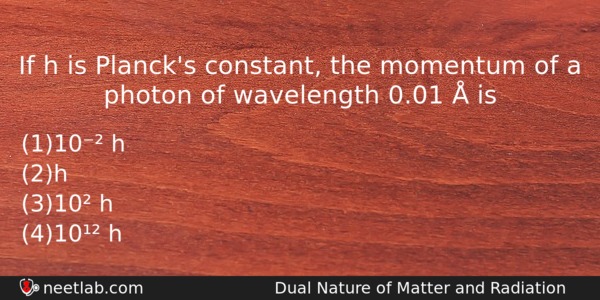
If h is Planck’s constant, the momentum of a photon of wavelength 0.01 Å is
Options
(a) 10⁻² h
(b) h
(c) 10² h
(d) 10¹² h
Correct Answer:
10¹² h
Explanation:
No explanation available. Be the first to write the explanation for this question by commenting below.
Related Questions: - An object placed at 20 cm in front of a concave mirror produces three times
- Ohm’s law valid
- An objective moves ,starting from rest through a resistive medium
- A ball is moving in a circular path of radius 5 m.If tangential acceleration
- The moment of inertia of a semicircular ring about the centre is
Topics: Dual Nature of Matter and Radiation
(150)
Subject: Physics
(2479)
Important MCQs Based on Medical Entrance Examinations To Improve Your NEET Score
- An object placed at 20 cm in front of a concave mirror produces three times
- Ohm’s law valid
- An objective moves ,starting from rest through a resistive medium
- A ball is moving in a circular path of radius 5 m.If tangential acceleration
- The moment of inertia of a semicircular ring about the centre is
Topics: Dual Nature of Matter and Radiation (150)
Subject: Physics (2479)
Important MCQs Based on Medical Entrance Examinations To Improve Your NEET Score
18000+ students are using NEETLab to improve their score. What about you?
Solve Previous Year MCQs, Mock Tests, Topicwise Practice Tests, Identify Weak Topics, Formula Flash cards and much more is available in NEETLab Android App to improve your NEET score.

Share this page with your friends
momentum is given by p=h/lambda
As h is constant so p is inversely proportional to lambda. The value of lambda is 0.01 angstrom I.e, 1×10² Angstrom. and angstrom is equals to 10 raised to the power 10. so the equation becomes p=1/1×102×1010. p=1/1×1012
p=10 raised to the power -12. So the answer is ×10-12.