| ⇦ | 
| ⇨ |
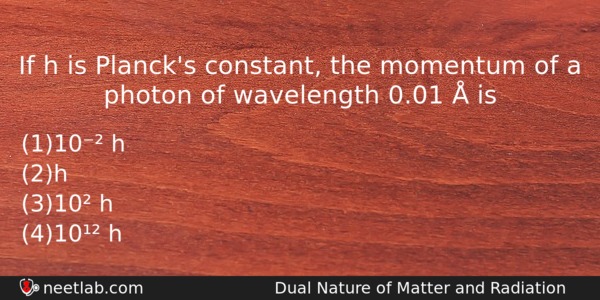
If h is Planck’s constant, the momentum of a photon of wavelength 0.01 Å is
Options
(a) 10⁻² h
(b) h
(c) 10² h
(d) 10¹² h
Correct Answer:
10¹² h
Explanation:
No explanation available. Be the first to write the explanation for this question by commenting below.
Related Questions: - If the density of earth is doubled keeping its radius constant then acceleration
- The area of cross-section of a steel wire (Y=2.0×10¹¹ N/m²) is 0.1 cm².
- In a circuit, the current lags behind the voltage by a phase difference of π/2.
- A particle moves in a circle of radius 5 cm with constant speed and time period
- Two similar springs P and Q have spring constants Kp and Kq, such that Kp>Kq.
Topics: Dual Nature of Matter and Radiation
(150)
Subject: Physics
(2479)
Important MCQs Based on Medical Entrance Examinations To Improve Your NEET Score
- If the density of earth is doubled keeping its radius constant then acceleration
- The area of cross-section of a steel wire (Y=2.0×10¹¹ N/m²) is 0.1 cm².
- In a circuit, the current lags behind the voltage by a phase difference of π/2.
- A particle moves in a circle of radius 5 cm with constant speed and time period
- Two similar springs P and Q have spring constants Kp and Kq, such that Kp>Kq.
Topics: Dual Nature of Matter and Radiation (150)
Subject: Physics (2479)
Important MCQs Based on Medical Entrance Examinations To Improve Your NEET Score
18000+ students are using NEETLab to improve their score. What about you?
Solve Previous Year MCQs, Mock Tests, Topicwise Practice Tests, Identify Weak Topics, Formula Flash cards and much more is available in NEETLab Android App to improve your NEET score.

Share this page with your friends
momentum is given by p=h/lambda
As h is constant so p is inversely proportional to lambda. The value of lambda is 0.01 angstrom I.e, 1×10² Angstrom. and angstrom is equals to 10 raised to the power 10. so the equation becomes p=1/1×102×1010. p=1/1×1012
p=10 raised to the power -12. So the answer is ×10-12.