| ⇦ | 
| ⇨ |
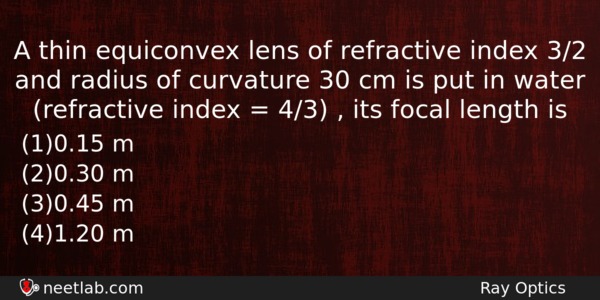
A thin equiconvex lens of refractive index 3/2 and radius of curvature 30 cm is put in water (refractive index = 4/3) , its focal length is
Options
(a) 0.15 m
(b) 0.30 m
(c) 0.45 m
(d) 1.20 m
Correct Answer:
1.20 m
Explanation:
No explanation available. Be the first to write the explanation for this question by commenting below.
Related Questions: - Wires A and B are made from the same material. A has twice the diameter and three times
- Two springs with spring constants K₁=1500 N/m and K₂=3000 N/m
- Work done by an external agent in separating the parallel plate capacitor is
- The angle of a prism is A. One of its refracting surfaces is silvered
- An a.c. supply gives 30 volt r.m.s which passes through a 10Ω resistance.
Topics: Ray Optics
(94)
Subject: Physics
(2479)
Important MCQs Based on Medical Entrance Examinations To Improve Your NEET Score
- Wires A and B are made from the same material. A has twice the diameter and three times
- Two springs with spring constants K₁=1500 N/m and K₂=3000 N/m
- Work done by an external agent in separating the parallel plate capacitor is
- The angle of a prism is A. One of its refracting surfaces is silvered
- An a.c. supply gives 30 volt r.m.s which passes through a 10Ω resistance.
Topics: Ray Optics (94)
Subject: Physics (2479)
Important MCQs Based on Medical Entrance Examinations To Improve Your NEET Score
18000+ students are using NEETLab to improve their score. What about you?
Solve Previous Year MCQs, Mock Tests, Topicwise Practice Tests, Identify Weak Topics, Formula Flash cards and much more is available in NEETLab Android App to improve your NEET score.

Share this page with your friends
According to lens maker’s formula
1f=(μ−1)(1R1−1R2)
where μ=μLμM
Here, μL=32, μM=43, R1=+30cm, R2=−30cm
∴1f=(3243−1)(130−1−30)
=(18)(230)
1f=14×30=1120
or f=120cm=1.2m