| ⇦ | 
| ⇨ |
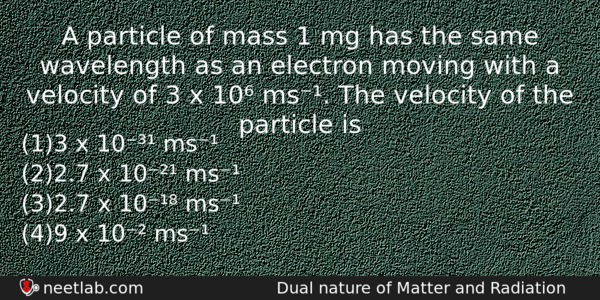
A particle of mass 1 mg has the same wavelength as an electron moving with a velocity of 3 x 10⁶ ms⁻¹. The velocity of the particle is
Options
(a) 3 x 10⁻³¹ ms⁻¹
(b) 2.7 x 10⁻²¹ ms⁻¹
(c) 2.7 x 10⁻¹⁸ ms⁻¹
(d) 9 x 10⁻² ms⁻¹
Correct Answer:
2.7 x 10⁻¹⁸ ms⁻¹
Explanation:
No explanation available. Be the first to write the explanation for this question by commenting below.
Related Questions: - Three resistances P,Q,R each of 2Ω and an unknown resistances S form the four arms
- The original temperature of a black body is 727⁰C. The temperature at which this black
- A wire of resistance 4 ohm is stretched to twice its original length.
- The time by a photoelectron to come out after the photon strikes is approximately
- A man goes 10 m towards north, then 20m towards east, the displacement is
Topics: Dual Nature of Matter and Radiation
(150)
Subject: Physics
(2479)
Important MCQs Based on Medical Entrance Examinations To Improve Your NEET Score
- Three resistances P,Q,R each of 2Ω and an unknown resistances S form the four arms
- The original temperature of a black body is 727⁰C. The temperature at which this black
- A wire of resistance 4 ohm is stretched to twice its original length.
- The time by a photoelectron to come out after the photon strikes is approximately
- A man goes 10 m towards north, then 20m towards east, the displacement is
Topics: Dual Nature of Matter and Radiation (150)
Subject: Physics (2479)
Important MCQs Based on Medical Entrance Examinations To Improve Your NEET Score
18000+ students are using NEETLab to improve their score. What about you?
Solve Previous Year MCQs, Mock Tests, Topicwise Practice Tests, Identify Weak Topics, Formula Flash cards and much more is available in NEETLab Android App to improve your NEET score.

Share this page with your friends
Leave a Reply