| ⇦ | 
| ⇨ |
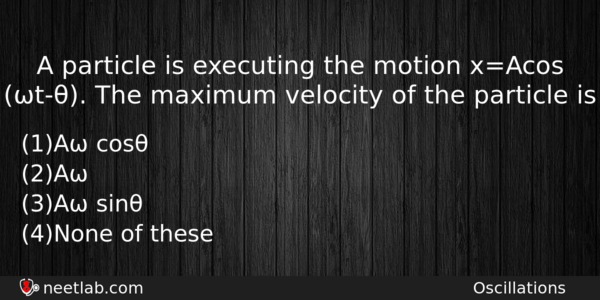
A particle is executing the motion x=Acos (ωt-θ). The maximum velocity of the particle is
Options
(a) Aω cosθ
(b) Aω
(c) Aω sinθ
(d) None of these
Correct Answer:
Aω
Explanation:
x = A cos (ωt – θ)
Velocity = dx/dt = -A sin (ωt – θ)
For maximum value, Since function should be = 1
Maximum velocity = -Aω
Related Questions: - A Carnot engine takes heat from a reservoir at 627⁰C and rejects heat
- Height of geostationary satellite is
- If the volume of a block of aluminium is decreased by 1%, the pressure
- Large transformers, when used for some time, become hot and are cooled by circulating
- A 100Ω resistance and a capacitor of 100Ω reactance are connected in series
Topics: Oscillations
(58)
Subject: Physics
(2479)
Important MCQs Based on Medical Entrance Examinations To Improve Your NEET Score
- A Carnot engine takes heat from a reservoir at 627⁰C and rejects heat
- Height of geostationary satellite is
- If the volume of a block of aluminium is decreased by 1%, the pressure
- Large transformers, when used for some time, become hot and are cooled by circulating
- A 100Ω resistance and a capacitor of 100Ω reactance are connected in series
Topics: Oscillations (58)
Subject: Physics (2479)
Important MCQs Based on Medical Entrance Examinations To Improve Your NEET Score
18000+ students are using NEETLab to improve their score. What about you?
Solve Previous Year MCQs, Mock Tests, Topicwise Practice Tests, Identify Weak Topics, Formula Flash cards and much more is available in NEETLab Android App to improve your NEET score.

Share this page with your friends
Leave a Reply