| ⇦ | 
| ⇨ |
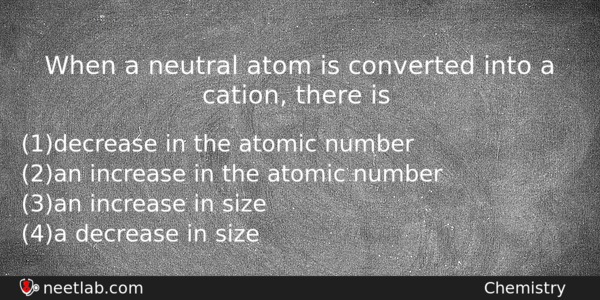
When a neutral atom is converted into a cation, there is
Options
(a) decrease in the atomic number
(b) an increase in the atomic number
(c) an increase in size
(d) a decrease in size
Correct Answer:
a decrease in size
Explanation:
During the conversion of a oneoutral atom into a cation, size decreases because after removal of one or more electron
(i) Nuclear charge per electron increases.
(ii) Outermost shell is completely removed.
Related Questions: - A certain mass of gas occupies a volume of 300 c.c. at 27⁰C and 620 mm pressure
- Which of the following acts as both reducing and oxidising agent
- Which one of the following pairs of solution is not an acidic buffer
- When CHCl₃ is boiled with NaOH, it gives
- The solubility of saturated solution of calcium fluoride is 2 ˣ 10⁻⁴ moles
Question Type: Memory
(964)
Difficulty Level: Easy
(1008)
Topics: Classification of Elements and Periodicity
(94)
Subject: Chemistry
(2512)
Important MCQs Based on Medical Entrance Examinations To Improve Your NEET Score
- A certain mass of gas occupies a volume of 300 c.c. at 27⁰C and 620 mm pressure
- Which of the following acts as both reducing and oxidising agent
- Which one of the following pairs of solution is not an acidic buffer
- When CHCl₃ is boiled with NaOH, it gives
- The solubility of saturated solution of calcium fluoride is 2 ˣ 10⁻⁴ moles
Question Type: Memory (964)
Difficulty Level: Easy (1008)
Topics: Classification of Elements and Periodicity (94)
Subject: Chemistry (2512)
Important MCQs Based on Medical Entrance Examinations To Improve Your NEET Score
18000+ students are using NEETLab to improve their score. What about you?
Solve Previous Year MCQs, Mock Tests, Topicwise Practice Tests, Identify Weak Topics, Formula Flash cards and much more is available in NEETLab Android App to improve your NEET score.

Share this page with your friends
Leave a Reply