| ⇦ | 
| ⇨ |
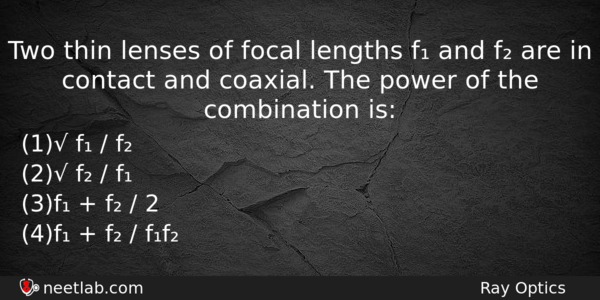
Two thin lenses of focal lengths f₁ and f₂ are in contact and coaxial. The power of the combination is:
Options
(a) √ f₁ / f₂
(b) √ f₂ / f₁
(c) f₁ + f₂ / 2
(d) f₁ + f₂ / f₁f₂
Correct Answer:
f₁ + f₂ / f₁f₂
Explanation:
The focal length of the combination
1/f = 1/f₁ + 1/f₂
Power of the combinations,
P = f₁ + f₂ / f₁ f₂ ( P = 1 / f )
Related Questions: - A bar magnet of moment M and pole strength m is cut into parts of equal lengths.
- Dependence of intensity of gravitational field (E) of earth with distance(r)
- A bullet of mass m moving with velocity v strikes a block of mass M at rests
- A thin film of soap solution (n=1.4) lies on the top of a glass plate (n=1.5).
- A series combination of resistor (R), capacitor (C), is connected to an AC source
Topics: Ray Optics
(94)
Subject: Physics
(2479)
Important MCQs Based on Medical Entrance Examinations To Improve Your NEET Score
- A bar magnet of moment M and pole strength m is cut into parts of equal lengths.
- Dependence of intensity of gravitational field (E) of earth with distance(r)
- A bullet of mass m moving with velocity v strikes a block of mass M at rests
- A thin film of soap solution (n=1.4) lies on the top of a glass plate (n=1.5).
- A series combination of resistor (R), capacitor (C), is connected to an AC source
Topics: Ray Optics (94)
Subject: Physics (2479)
Important MCQs Based on Medical Entrance Examinations To Improve Your NEET Score
18000+ students are using NEETLab to improve their score. What about you?
Solve Previous Year MCQs, Mock Tests, Topicwise Practice Tests, Identify Weak Topics, Formula Flash cards and much more is available in NEETLab Android App to improve your NEET score.

Share this page with your friends
Leave a Reply