| ⇦ | 
| ⇨ |
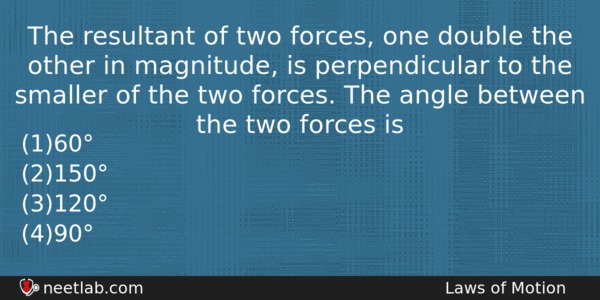
The resultant of two forces, one double the other in magnitude, is perpendicular to the smaller of the two forces. The angle between the two forces is
Options
(a) 60°
(b) 150°
(c) 120°
(d) 90°
Correct Answer:
120°
Explanation:
No explanation available. Be the first to write the explanation for this question by commenting below.
Related Questions: - In common base circuit of a transistor, current amplification factor is 0.95.
- α-particles, deuterons and protons of same energy are moving in a perpendicular
- An electron of mass m and a photon have same energy E. The ratio of de-Broglie
- A 70 kg man stands in contact against the inner wall of a hollow cylindrical drum
- In Young’s double silt experiment if the distance between the two slits
Topics: Laws of Motion
(103)
Subject: Physics
(2479)
Important MCQs Based on Medical Entrance Examinations To Improve Your NEET Score
- In common base circuit of a transistor, current amplification factor is 0.95.
- α-particles, deuterons and protons of same energy are moving in a perpendicular
- An electron of mass m and a photon have same energy E. The ratio of de-Broglie
- A 70 kg man stands in contact against the inner wall of a hollow cylindrical drum
- In Young’s double silt experiment if the distance between the two slits
Topics: Laws of Motion (103)
Subject: Physics (2479)
Important MCQs Based on Medical Entrance Examinations To Improve Your NEET Score
18000+ students are using NEETLab to improve their score. What about you?
Solve Previous Year MCQs, Mock Tests, Topicwise Practice Tests, Identify Weak Topics, Formula Flash cards and much more is available in NEETLab Android App to improve your NEET score.

Share this page with your friends
Nice