| ⇦ | 
| ⇨ |
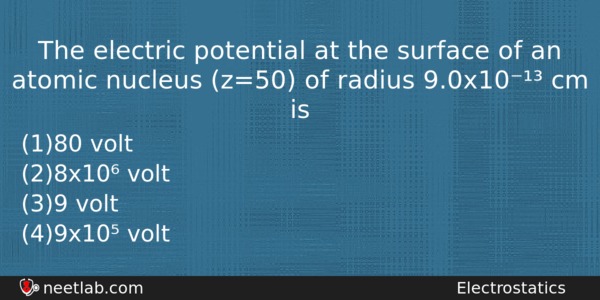
The electric potential at the surface of an atomic nucleus (z=50) of radius 9.0×10⁻¹³ cm is
Options
(a) 80 volt
(b) 8×10⁶ volt
(c) 9 volt
(d) 9×10⁵ volt
Correct Answer:
8×10⁶ volt
Explanation:
V = (1 / 4πε₀). q/r
= [9 × 10⁹ × 50 × 1.6 × 10⁻¹⁹] / 9 × 10⁻¹⁵
= 8 × 10⁶ volt
Related Questions: - A steady current of 1.5 amp flows through a copper voltmeter for 10 minutes
- A spherical drop of capacitance 1μF is broken into eight drops of equal radius.
- A uniform force of (3i+j) Nacts on a particle of mass 2 kg.Hence the particle is displaced
- In an ammeter, 0.2% of main current passes through the galvanometer
- A wire elongates by l mm when a load W is hanged from it. If the wire goes over
Topics: Electrostatics
(146)
Subject: Physics
(2479)
Important MCQs Based on Medical Entrance Examinations To Improve Your NEET Score
- A steady current of 1.5 amp flows through a copper voltmeter for 10 minutes
- A spherical drop of capacitance 1μF is broken into eight drops of equal radius.
- A uniform force of (3i+j) Nacts on a particle of mass 2 kg.Hence the particle is displaced
- In an ammeter, 0.2% of main current passes through the galvanometer
- A wire elongates by l mm when a load W is hanged from it. If the wire goes over
Topics: Electrostatics (146)
Subject: Physics (2479)
Important MCQs Based on Medical Entrance Examinations To Improve Your NEET Score
18000+ students are using NEETLab to improve their score. What about you?
Solve Previous Year MCQs, Mock Tests, Topicwise Practice Tests, Identify Weak Topics, Formula Flash cards and much more is available in NEETLab Android App to improve your NEET score.

Share this page with your friends
Leave a Reply