| ⇦ | 
| ⇨ |
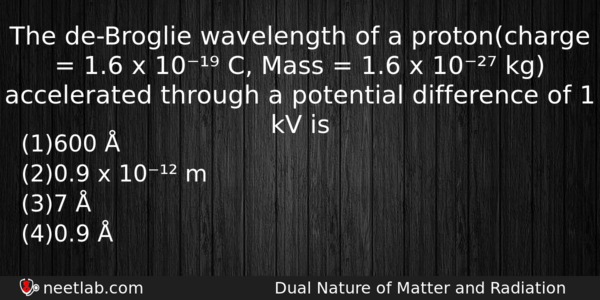
The de-Broglie wavelength of a proton(charge = 1.6 x 10⁻¹⁹ C, Mass = 1.6 x 10⁻²⁷ kg) accelerated through a potential difference of 1 kV is
Options
(a) 600 Å
(b) 0.9 x 10⁻¹² m
(c) 7 Å
(d) 0.9 Å
Correct Answer:
0.9 x 10⁻¹² m
Explanation:
No explanation available. Be the first to write the explanation for this question by commenting below.
Related Questions: - If h is Planck’s constant, the momentum of a photon of wavelength 0.01 Å is
- The wavelength of Kα line in copper is 1.5Å. The ionisation energy of K electron in copper is
- Two simple harmonic motions of angular frequency 100 and 1000 rad s⁻¹ have the same
- Two charges placed in air repel each other by a force of 10⁻⁴ N. When oil is
- At the first minimum adjacent to the central maximum of a single-slit diffraction
Topics: Dual Nature of Matter and Radiation
(150)
Subject: Physics
(2479)
Important MCQs Based on Medical Entrance Examinations To Improve Your NEET Score
- If h is Planck’s constant, the momentum of a photon of wavelength 0.01 Å is
- The wavelength of Kα line in copper is 1.5Å. The ionisation energy of K electron in copper is
- Two simple harmonic motions of angular frequency 100 and 1000 rad s⁻¹ have the same
- Two charges placed in air repel each other by a force of 10⁻⁴ N. When oil is
- At the first minimum adjacent to the central maximum of a single-slit diffraction
Topics: Dual Nature of Matter and Radiation (150)
Subject: Physics (2479)
Important MCQs Based on Medical Entrance Examinations To Improve Your NEET Score
18000+ students are using NEETLab to improve their score. What about you?
Solve Previous Year MCQs, Mock Tests, Topicwise Practice Tests, Identify Weak Topics, Formula Flash cards and much more is available in NEETLab Android App to improve your NEET score.

Share this page with your friends
Leave a Reply