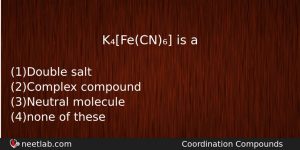
K₄[Fe(CN)₆] is a
K₄[Fe(CN)₆] is a
Options
(a) Double salt (b) Complex compound (c) Neutral molecule (d) none of these
Correct Answer:
Complex compound
Explanation:
No explanation available. Be the first to write the explanation for […]
K₄[Fe(CN)₆] is a
Options
(a) Double salt (b) Complex compound (c) Neutral molecule (d) none of these
Correct Answer:
Complex compound
Explanation:
No explanation available. Be the first to write the explanation for […]
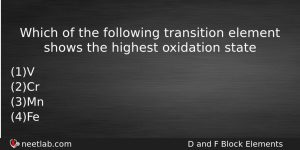
Which of the following transition element shows the highest oxidation state
Options
(a) V (b) Cr (c) Mn (d) Fe
Correct Answer:
Mn
Explanation:
No explanation available. Be the first to write the […]
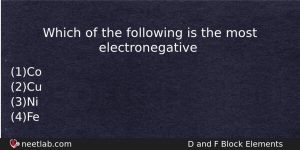
Which of the following is the most electronegative
Options
(a) Co (b) Cu (c) Ni (d) Fe
Correct Answer:
Cu
Explanation:
No explanation available. Be the first to write the explanation for this […]
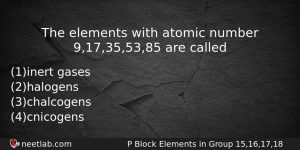
The elements with atomic number 9,17,35,53,85 are called
Options
(a) inert gases (b) halogens (c) chalcogens (d) cnicogens
Correct Answer:
halogens
Explanation:
No explanation available. Be the first to write the explanation for […]

In NH₃ and PH₃, the common feature is
Options
(a) basic nature (b) odour (c) acidic nature (d) combustibility
Correct Answer:
basic nature
Explanation:
No explanation available. Be the first to write the […]
Electrophoresis is the movement of colloidal particles under the effect of
Options
(a) light (b) gravity (c) magnetic field (d) electric field
Correct Answer:
electric field
Explanation:
No explanation available. Be […]
Lyophilic colloids are stable due to
Options
(a) small size of the particle (b) large size of particle (c) charge on the particle (d) layer of dispersion medium on the particles
Correct Answer: […]
Standard electrode potential for Sn⁴⁺/Sn²⁺ couple is +0.15 V and that for the Cr³⁺/Cr couple is -0.74 V. These two couples in their standard state are connected to make a cell. The cell potential will […]
Which of the following will not displace hydrogen
Options
(a) Hg (b) Pb (c) Ba (d) Sn
Correct Answer:
Hg
Explanation:
Mercury lies below hydrogen in the electrochemical series so it will not […]
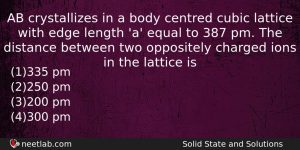
AB crystallizes in a body centred cubic lattice with edge length ‘a’ equal to 387 pm. The distance between two oppositely charged ions in the lattice is
Options
(a) 335 pm (b) 250 […]
2017-2025 Copyright Doctor Dreams Training Academy - About Us - Privacy Policy - Terms & Conditions - Contact Us - Refund Policy