| ⇦ | 
| ⇨ |
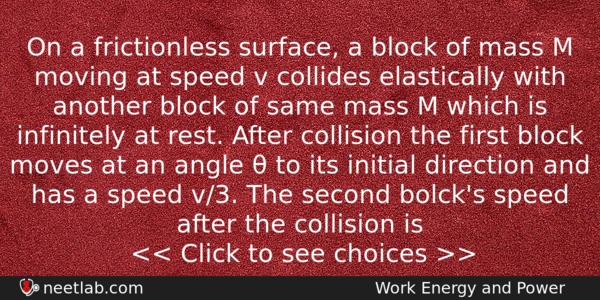
On a frictionless surface, a block of mass M moving at speed v collides elastically with another block of same mass M which is infinitely at rest. After collision the first block moves at an angle θ to its initial direction and has a speed v/3. The second bolck’s speed after the collision is
Options
(a) 3/√2 v
(b) √3/2 v
(c) 2√2/3 v
(d) 3/4 v
Correct Answer:
2√2/3 v
Explanation:
No explanation available. Be the first to write the explanation for this question by commenting below.
Related Questions: - A capacitor is charged to 200 volt. It has a charge of 0.1 coulomb.
- The time by a photoelectron to come out after the photon strikes is approximately
- The quantity having the same units in all systems of unit is
- A 200 W sodium street lamp emits yellow light of wavelength 0.6 µm
- The relationship between decay constant λ and half-life T of a radioactive substance is
Topics: Work Energy and Power
(94)
Subject: Physics
(2479)
Important MCQs Based on Medical Entrance Examinations To Improve Your NEET Score
- A capacitor is charged to 200 volt. It has a charge of 0.1 coulomb.
- The time by a photoelectron to come out after the photon strikes is approximately
- The quantity having the same units in all systems of unit is
- A 200 W sodium street lamp emits yellow light of wavelength 0.6 µm
- The relationship between decay constant λ and half-life T of a radioactive substance is
Topics: Work Energy and Power (94)
Subject: Physics (2479)
Important MCQs Based on Medical Entrance Examinations To Improve Your NEET Score
18000+ students are using NEETLab to improve their score. What about you?
Solve Previous Year MCQs, Mock Tests, Topicwise Practice Tests, Identify Weak Topics, Formula Flash cards and much more is available in NEETLab Android App to improve your NEET score.

Share this page with your friends
Leave a Reply