| ⇦ | 
| ⇨ |
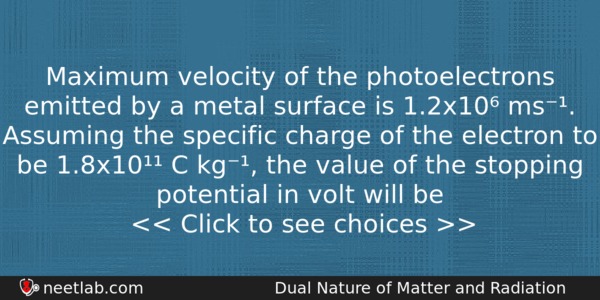
Maximum velocity of the photoelectrons emitted by a metal surface is 1.2×10⁶ ms⁻¹. Assuming the specific charge of the electron to be 1.8×10¹¹ C kg⁻¹, the value of the stopping potential in volt will be
Options
(a) 2
(b) 3
(c) 4
(d) 6
Correct Answer:
4
Explanation:
No explanation available. Be the first to write the explanation for this question by commenting below.
Related Questions: - Given A=4i+6j and B=2i+3j. Which of the following is correct?
- Which of the following phenomena support the wave theory of light?
- If critical angle for a material to air passage is 30°, the refractive index
- A galvanometer has a coil of resistance 100 ohm and gives a full-scale deflection
- A uniform plank of Young’s modulus Y is moved over a smooth horizontal surface
Topics: Dual Nature of Matter and Radiation
(150)
Subject: Physics
(2479)
Important MCQs Based on Medical Entrance Examinations To Improve Your NEET Score
- Given A=4i+6j and B=2i+3j. Which of the following is correct?
- Which of the following phenomena support the wave theory of light?
- If critical angle for a material to air passage is 30°, the refractive index
- A galvanometer has a coil of resistance 100 ohm and gives a full-scale deflection
- A uniform plank of Young’s modulus Y is moved over a smooth horizontal surface
Topics: Dual Nature of Matter and Radiation (150)
Subject: Physics (2479)
Important MCQs Based on Medical Entrance Examinations To Improve Your NEET Score
18000+ students are using NEETLab to improve their score. What about you?
Solve Previous Year MCQs, Mock Tests, Topicwise Practice Tests, Identify Weak Topics, Formula Flash cards and much more is available in NEETLab Android App to improve your NEET score.

Share this page with your friends
ev=(1/2)mV^2max
v= (mV^2max)/2e
=(V^2max)/2 (e/m)
=((1.2×10^6)^2)/(2×1.8×10^11)=4v