| ⇦ | 
| ⇨ |
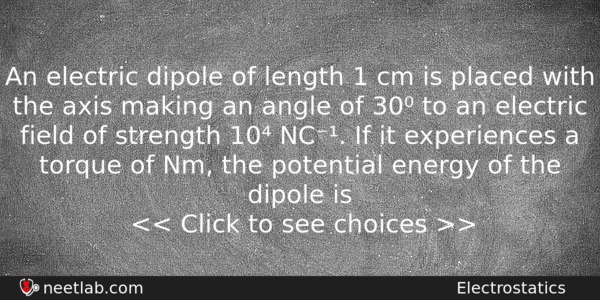
An electric dipole of length 1 cm is placed with the axis making an angle of 30⁰ to an electric field of strength 10⁴ NC⁻¹. If it experiences a torque of Nm, the potential energy of the dipole is
Options
(a) 2.45 J
(b) 0.0245 J
(c) 245.0 J
(d) 24.5 J
Correct Answer:
24.5 J
Explanation:
No explanation available. Be the first to write the explanation for this question by commenting below.
Related Questions: - By the succesive disintegration of ₉₂U²³⁸, the final product obtained is ₈₂Pb²⁰⁶, then
- A satellite is launched into a circular orbit of radius R around earth while
- The dimension of 1/2ε₀E², where ε₀ is permittivity of free space and E is electric field
- A particle is executing the motion x=Acos (ωt-θ). The maximum velocity of the particle is
- If a charge in current of 0.01 A in one coil produces a change in magnetic flux
Topics: Electrostatics
(146)
Subject: Physics
(2479)
Important MCQs Based on Medical Entrance Examinations To Improve Your NEET Score
- By the succesive disintegration of ₉₂U²³⁸, the final product obtained is ₈₂Pb²⁰⁶, then
- A satellite is launched into a circular orbit of radius R around earth while
- The dimension of 1/2ε₀E², where ε₀ is permittivity of free space and E is electric field
- A particle is executing the motion x=Acos (ωt-θ). The maximum velocity of the particle is
- If a charge in current of 0.01 A in one coil produces a change in magnetic flux
Topics: Electrostatics (146)
Subject: Physics (2479)
Important MCQs Based on Medical Entrance Examinations To Improve Your NEET Score
18000+ students are using NEETLab to improve their score. What about you?
Solve Previous Year MCQs, Mock Tests, Topicwise Practice Tests, Identify Weak Topics, Formula Flash cards and much more is available in NEETLab Android App to improve your NEET score.

Share this page with your friends
Torque=PE sin¢
10√2= P×10^4 sin 30°
P=2√2×10^-3
U=PE cos 30°
U=2√2×10^-3× 10^4 cos 30°
=24.5 J
Torque=PE sin¢
10√2= P×10^4 sin 30°
P=2√2×10^-3
U=PE cos 30°
U=2√2×10^-3× 10^4 cos 30°
=24.5 J
Torque=PE sin¢
10√2= P×10^4 sin 30°
P=2√2×10^-3
U=PE cos 30°
U=2√2×10^-3× 10^4 cos 30°
=24.5 J