| ⇦ | 
| ⇨ |
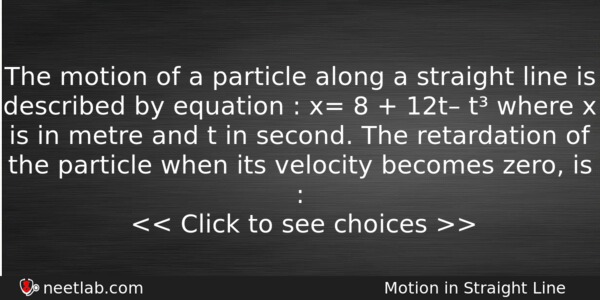
The motion of a particle along a straight line is described by equation : x= 8 + 12t– t³ where x is in metre and t in second. The retardation of the particle when its velocity becomes zero, is :
Options
(a) 24 ms⁻²
(b) zero
(c) 6ms⁻²
(d) 12 ms⁻²
Correct Answer:
12 ms⁻²
Explanation:
x = 8 + 12t – t³ The final velocity of the particle will be zero, because it retarded.
V= 0 + 12 – 3t² = 0 ⇒ 3t² = 12 ⇒ t = 2 sec
Now the retardation a = dv/ dt = 0 – 6t
a [ t= 2] = – 12 m/s²
retardation = 12 m/s²
Related Questions: - A thin film of soap solution (n=1.4) lies on the top of a glass plate (n=1.5).
- A particle having a mass of 10⁻² kg carries a charge of 5 x 10⁻⁸C
- A mixture consists of two radioactive materials A₁ and A₂ with half lives of 20s
- The rest energy of an electron is
- The minimum wavelength of X-rays produced in a Collidge tube operated
Topics: Motion in Straight Line
(93)
Subject: Physics
(2479)
Important MCQs Based on Medical Entrance Examinations To Improve Your NEET Score
- A thin film of soap solution (n=1.4) lies on the top of a glass plate (n=1.5).
- A particle having a mass of 10⁻² kg carries a charge of 5 x 10⁻⁸C
- A mixture consists of two radioactive materials A₁ and A₂ with half lives of 20s
- The rest energy of an electron is
- The minimum wavelength of X-rays produced in a Collidge tube operated
Topics: Motion in Straight Line (93)
Subject: Physics (2479)
Important MCQs Based on Medical Entrance Examinations To Improve Your NEET Score
18000+ students are using NEETLab to improve their score. What about you?
Solve Previous Year MCQs, Mock Tests, Topicwise Practice Tests, Identify Weak Topics, Formula Flash cards and much more is available in NEETLab Android App to improve your NEET score.

Share this page with your friends
Leave a Reply