| ⇦ | 
| ⇨ |
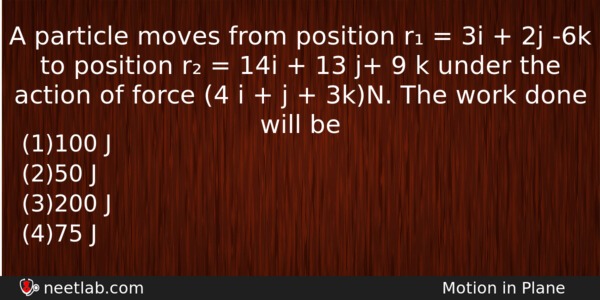
A particle moves from position r₁ = 3i + 2j -6k to position r₂ = 14i + 13 j+ 9 k under the action of force (4 i + j + 3k)N. The work done will be
Options
(a) 100 J
(b) 50 J
(c) 200 J
(d) 75 J
Correct Answer:
100 J
Explanation:
No explanation available. Be the first to write the explanation for this question by commenting below.
Related Questions: - An electric kettle takes 4A current at 220 V. How much time will it take to boil 1 kg
- The sun light reaches us as white and not as its components because
- Imagine a new planet having the same density as that of earth but it is 3 times bigger
- Shearing stress causes change in
- Water rises in a vertical capillary tube up to a height of 2.0 cm.
Topics: Motion in Plane
(93)
Subject: Physics
(2479)
Important MCQs Based on Medical Entrance Examinations To Improve Your NEET Score
- An electric kettle takes 4A current at 220 V. How much time will it take to boil 1 kg
- The sun light reaches us as white and not as its components because
- Imagine a new planet having the same density as that of earth but it is 3 times bigger
- Shearing stress causes change in
- Water rises in a vertical capillary tube up to a height of 2.0 cm.
Topics: Motion in Plane (93)
Subject: Physics (2479)
Important MCQs Based on Medical Entrance Examinations To Improve Your NEET Score
18000+ students are using NEETLab to improve their score. What about you?
Solve Previous Year MCQs, Mock Tests, Topicwise Practice Tests, Identify Weak Topics, Formula Flash cards and much more is available in NEETLab Android App to improve your NEET score.

Share this page with your friends
Leave a Reply