| ⇦ | 
| ⇨ |
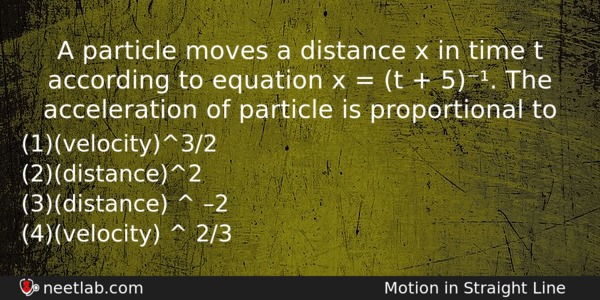
A particle moves a distance x in time t according to equation x = (t + 5)⁻¹. The acceleration of particle is proportional to
Options
(a) (velocity)^3/2
(b) (distance)^2
(c) (distance) ^ –2
(d) (velocity) ^ 2/3
Correct Answer:
(velocity)^3/2
Explanation:
x = 1 / t + 5
v = dx / dt = -1 / (t + 5)²
a = d²x / dt² = 2 / (t + 5)³ = 2x³
Now, 1 / (t + 5) ∞ v½
1 / (t + 5)³ ∞ v³/² ∞ a
Related Questions: - Which is incorrect about thermal process
- A body rolls down a stair case of 5 steps. Each step has height 0.1 m and width 0.1m
- Two cities are 150 km apart. Electric power is sent from one city to another city
- When the speed of electron beam used in Young’s double slit experiment is increased,
- In the phenomenon of electric discharge through gases at low pressure,
Topics: Motion in Straight Line
(93)
Subject: Physics
(2479)
Important MCQs Based on Medical Entrance Examinations To Improve Your NEET Score
- Which is incorrect about thermal process
- A body rolls down a stair case of 5 steps. Each step has height 0.1 m and width 0.1m
- Two cities are 150 km apart. Electric power is sent from one city to another city
- When the speed of electron beam used in Young’s double slit experiment is increased,
- In the phenomenon of electric discharge through gases at low pressure,
Topics: Motion in Straight Line (93)
Subject: Physics (2479)
Important MCQs Based on Medical Entrance Examinations To Improve Your NEET Score
18000+ students are using NEETLab to improve their score. What about you?
Solve Previous Year MCQs, Mock Tests, Topicwise Practice Tests, Identify Weak Topics, Formula Flash cards and much more is available in NEETLab Android App to improve your NEET score.

Share this page with your friends
Thankyou