| ⇦ | 
| ⇨ |
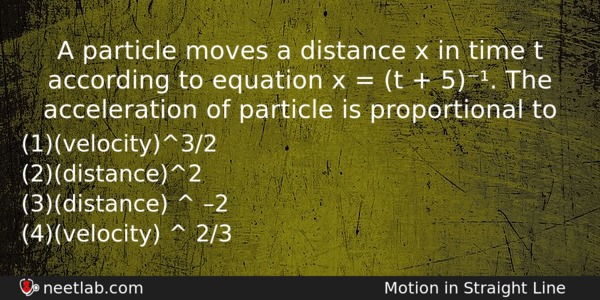
A particle moves a distance x in time t according to equation x = (t + 5)⁻¹. The acceleration of particle is proportional to
Options
(a) (velocity)^3/2
(b) (distance)^2
(c) (distance) ^ –2
(d) (velocity) ^ 2/3
Correct Answer:
(velocity)^3/2
Explanation:
x = 1 / t + 5
v = dx / dt = -1 / (t + 5)²
a = d²x / dt² = 2 / (t + 5)³ = 2x³
Now, 1 / (t + 5) ∞ v½
1 / (t + 5)³ ∞ v³/² ∞ a
Related Questions: - A satellite S is moving in an elliptical orbit around the earth. The mass
- A light whose frequency is equal to 6.0 x 10¹⁴ Hz is incident on a metal
- Which of the following phenomena does not show the wavenature of light?
- Unit of reduction factor is
- A conductor of length 5 cm is moved parallel to itself with a speed of 2 m/s,
Topics: Motion in Straight Line
(93)
Subject: Physics
(2479)
Important MCQs Based on Medical Entrance Examinations To Improve Your NEET Score
- A satellite S is moving in an elliptical orbit around the earth. The mass
- A light whose frequency is equal to 6.0 x 10¹⁴ Hz is incident on a metal
- Which of the following phenomena does not show the wavenature of light?
- Unit of reduction factor is
- A conductor of length 5 cm is moved parallel to itself with a speed of 2 m/s,
Topics: Motion in Straight Line (93)
Subject: Physics (2479)
Important MCQs Based on Medical Entrance Examinations To Improve Your NEET Score
18000+ students are using NEETLab to improve their score. What about you?
Solve Previous Year MCQs, Mock Tests, Topicwise Practice Tests, Identify Weak Topics, Formula Flash cards and much more is available in NEETLab Android App to improve your NEET score.

Share this page with your friends
Thankyou