| ⇦ | 
| ⇨ |
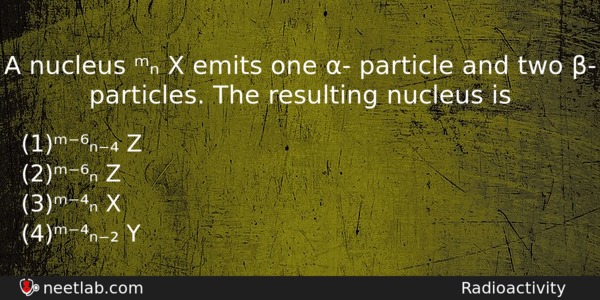
A nucleus ᵐₙ X emits one α- particle and two β- particles. The resulting nucleus is
Options
(a) ᵐ⁻⁶ₙ₋₄ Z
(b) ᵐ⁻⁶ₙ Z
(c) ᵐ⁻⁴ₙ X
(d) ᵐ⁻⁴ₙ₋₂ Y
Correct Answer:
ᵐ⁻⁴ₙ X
Explanation:
When ᵐₙ X emits one α- particle then its atomic mass decreases by 4 units and atomic number4 by 2. Therefore, the new nucleus becomes ᵐ⁻⁴ₙ₋₂ Y. But as it emits two β⁻ particles, its atomic number incre4ases by 2. Thus the resulting nucleus is ᵐ⁻⁴ₙ X.
Related Questions: - When an input signal 1 is applied to a NOT gate, then its output is
- The point of suspension λ of a simple pendulum with normal time period T₁ is moving
- 24 cells of emf 1.5 V each having internal resistance of 1 ohm are connected
- Mass of the nucleons together in a heavy nucleus is
- A L-C-R circuit with L=1.00 mH, C=10μF and R=50Ω, is driven with 5 V AC voltage.
Topics: Radioactivity
(83)
Subject: Physics
(2479)
Important MCQs Based on Medical Entrance Examinations To Improve Your NEET Score
- When an input signal 1 is applied to a NOT gate, then its output is
- The point of suspension λ of a simple pendulum with normal time period T₁ is moving
- 24 cells of emf 1.5 V each having internal resistance of 1 ohm are connected
- Mass of the nucleons together in a heavy nucleus is
- A L-C-R circuit with L=1.00 mH, C=10μF and R=50Ω, is driven with 5 V AC voltage.
Topics: Radioactivity (83)
Subject: Physics (2479)
Important MCQs Based on Medical Entrance Examinations To Improve Your NEET Score
18000+ students are using NEETLab to improve their score. What about you?
Solve Previous Year MCQs, Mock Tests, Topicwise Practice Tests, Identify Weak Topics, Formula Flash cards and much more is available in NEETLab Android App to improve your NEET score.

Share this page with your friends
Leave a Reply