| ⇦ | 
| ⇨ |
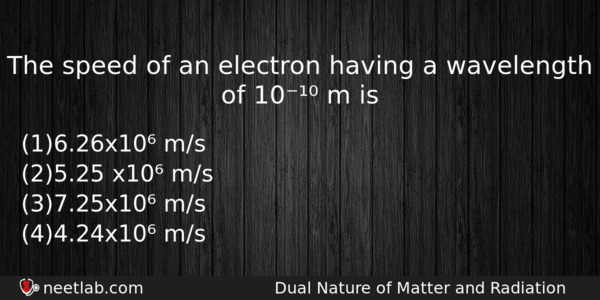
The speed of an electron having a wavelength of 10⁻¹⁰ m is
Options
(a) 6.26×10⁶ m/s
(b) 5.25 x10⁶ m/s
(c) 7.25×10⁶ m/s
(d) 4.24×10⁶ m/s
Correct Answer:
7.25×10⁶ m/s
Explanation:
λ = h / momentum = h / mv
v = h / mλ = 6.6 × 10⁻³⁴ / (9 × 10⁻³¹) × 10⁻¹°
v = 7.25 × 10⁶ ms⁻¹
Related Questions: - Two coherent monochromatic beams of intensities I and 4I respectively, are superposed.
- What determines the nature of the path followed by the particle?
- In a vessel, the gas is at a pressure P. If the mass of all the molecules
- In a P-N junction
- Solar radiation is
Topics: Dual Nature of Matter and Radiation
(150)
Subject: Physics
(2479)
Important MCQs Based on Medical Entrance Examinations To Improve Your NEET Score
- Two coherent monochromatic beams of intensities I and 4I respectively, are superposed.
- What determines the nature of the path followed by the particle?
- In a vessel, the gas is at a pressure P. If the mass of all the molecules
- In a P-N junction
- Solar radiation is
Topics: Dual Nature of Matter and Radiation (150)
Subject: Physics (2479)
Important MCQs Based on Medical Entrance Examinations To Improve Your NEET Score
18000+ students are using NEETLab to improve their score. What about you?
Solve Previous Year MCQs, Mock Tests, Topicwise Practice Tests, Identify Weak Topics, Formula Flash cards and much more is available in NEETLab Android App to improve your NEET score.

Share this page with your friends
P=h/lamba…..1equ
P= momentum
H=Planck’s constant
Lamba= wavelength
And
P=MV…..2 equ
M= mass
V= speed
Put 2 in 1
MV=h/lamba
9.1×10^-31*v=6.6×10^-34/10^-10
By solving u get the value of v
V=0.725*10^7=7.25*10^6