| ⇦ | 
| ⇨ |
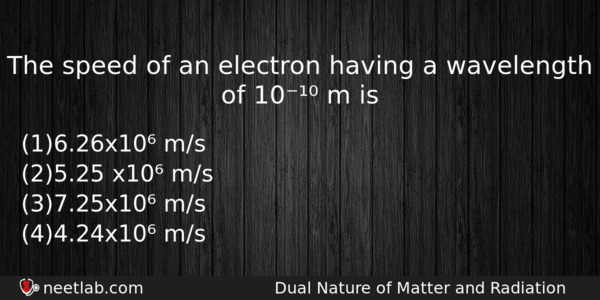
The speed of an electron having a wavelength of 10⁻¹⁰ m is
Options
(a) 6.26×10⁶ m/s
(b) 5.25 x10⁶ m/s
(c) 7.25×10⁶ m/s
(d) 4.24×10⁶ m/s
Correct Answer:
7.25×10⁶ m/s
Explanation:
λ = h / momentum = h / mv
v = h / mλ = 6.6 × 10⁻³⁴ / (9 × 10⁻³¹) × 10⁻¹°
v = 7.25 × 10⁶ ms⁻¹
Related Questions: - What is the wavelength of light for the least energetic photon emitted
- Two lines of force due to a bar magnet
- The earth is assumed to be a sphere of radius R. A platform is arranged at a height R
- Two sources P and Q produce notes of frequency 660 Hz each.
- Which of the following quantities has units but not dimensions
Topics: Dual Nature of Matter and Radiation
(150)
Subject: Physics
(2479)
Important MCQs Based on Medical Entrance Examinations To Improve Your NEET Score
- What is the wavelength of light for the least energetic photon emitted
- Two lines of force due to a bar magnet
- The earth is assumed to be a sphere of radius R. A platform is arranged at a height R
- Two sources P and Q produce notes of frequency 660 Hz each.
- Which of the following quantities has units but not dimensions
Topics: Dual Nature of Matter and Radiation (150)
Subject: Physics (2479)
Important MCQs Based on Medical Entrance Examinations To Improve Your NEET Score
18000+ students are using NEETLab to improve their score. What about you?
Solve Previous Year MCQs, Mock Tests, Topicwise Practice Tests, Identify Weak Topics, Formula Flash cards and much more is available in NEETLab Android App to improve your NEET score.

Share this page with your friends
P=h/lamba…..1equ
P= momentum
H=Planck’s constant
Lamba= wavelength
And
P=MV…..2 equ
M= mass
V= speed
Put 2 in 1
MV=h/lamba
9.1×10^-31*v=6.6×10^-34/10^-10
By solving u get the value of v
V=0.725*10^7=7.25*10^6