| ⇦ | 
| ⇨ |
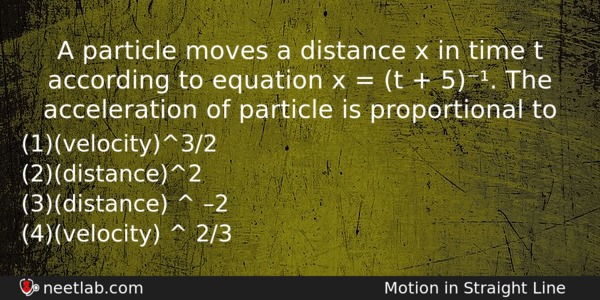
A particle moves a distance x in time t according to equation x = (t + 5)⁻¹. The acceleration of particle is proportional to
Options
(a) (velocity)^3/2
(b) (distance)^2
(c) (distance) ^ –2
(d) (velocity) ^ 2/3
Correct Answer:
(velocity)^3/2
Explanation:
x = 1 / t + 5
v = dx / dt = -1 / (t + 5)²
a = d²x / dt² = 2 / (t + 5)³ = 2x³
Now, 1 / (t + 5) ∞ v½
1 / (t + 5)³ ∞ v³/² ∞ a
Related Questions: - The position vector of a particle R as a function of time is given by
- A shell of mass 200 g is ejected from a gun of mass 4 kg by an explosion
- One mole of an ideal gas at an initial temperature of T K, does 6R joule of work
- The charge flowing through a resistance R varies with time t as Q=at-bt²,
- In refraction, light waves are bent on passing from one medium to the second medium
Topics: Motion in Straight Line
(93)
Subject: Physics
(2479)
Important MCQs Based on Medical Entrance Examinations To Improve Your NEET Score
- The position vector of a particle R as a function of time is given by
- A shell of mass 200 g is ejected from a gun of mass 4 kg by an explosion
- One mole of an ideal gas at an initial temperature of T K, does 6R joule of work
- The charge flowing through a resistance R varies with time t as Q=at-bt²,
- In refraction, light waves are bent on passing from one medium to the second medium
Topics: Motion in Straight Line (93)
Subject: Physics (2479)
Important MCQs Based on Medical Entrance Examinations To Improve Your NEET Score
18000+ students are using NEETLab to improve their score. What about you?
Solve Previous Year MCQs, Mock Tests, Topicwise Practice Tests, Identify Weak Topics, Formula Flash cards and much more is available in NEETLab Android App to improve your NEET score.

Share this page with your friends
Thankyou