| ⇦ | 
| ⇨ |
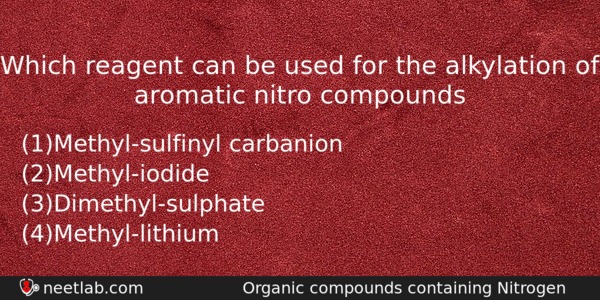
Which reagent can be used for the alkylation of aromatic nitro compounds
Options
(a) Methyl-sulfinyl carbanion
(b) Methyl-iodide
(c) Dimethyl-sulphate
(d) Methyl-lithium
Correct Answer:
Methyl-sulfinyl carbanion
Explanation:
Ar – NO₂ group is ring deactivating group. So it does not favour electrophilic alkylation in benzene ring . Therefore nitrobenzene undergoes nucleophilic alkylation through carbanion intermediate. So the reagent used is methyl sulfinyl carbaion.
Related Questions: - In Kjeldahl’s mathod, the nitrogen present is estimated as
- Na₂CO₃ is manufactured by solvay process, the products that are recycled are
- Solution of 0.1 N NH₄OH and 0.1 N NH₄Cl has pH 9.25 . Then fine out pKb of NH₄OH
- Which of the following is not a thermodynamic function
- Biodegradable polymer which can be produced from glycine and aminocapronic acid is
Topics: Organic compounds containing Nitrogen
(87)
Subject: Chemistry
(2512)
Important MCQs Based on Medical Entrance Examinations To Improve Your NEET Score
- In Kjeldahl’s mathod, the nitrogen present is estimated as
- Na₂CO₃ is manufactured by solvay process, the products that are recycled are
- Solution of 0.1 N NH₄OH and 0.1 N NH₄Cl has pH 9.25 . Then fine out pKb of NH₄OH
- Which of the following is not a thermodynamic function
- Biodegradable polymer which can be produced from glycine and aminocapronic acid is
Topics: Organic compounds containing Nitrogen (87)
Subject: Chemistry (2512)
Important MCQs Based on Medical Entrance Examinations To Improve Your NEET Score
18000+ students are using NEETLab to improve their score. What about you?
Solve Previous Year MCQs, Mock Tests, Topicwise Practice Tests, Identify Weak Topics, Formula Flash cards and much more is available in NEETLab Android App to improve your NEET score.

Share this page with your friends
Leave a Reply