| ⇦ | 
| ⇨ |
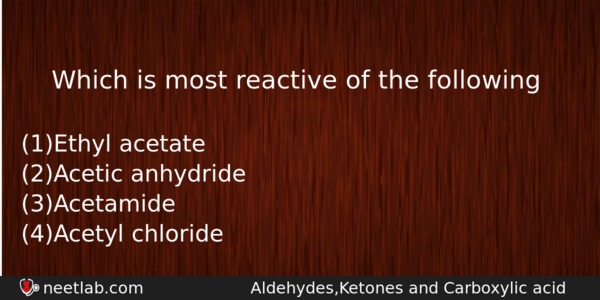
Which is most reactive of the following
Options
(a) Ethyl acetate
(b) Acetic anhydride
(c) Acetamide
(d) Acetyl chloride
Correct Answer:
Acetyl chloride
Explanation:
The order of reactivity of acid derivatives toward different reactions decreases in the order: RCOCl > (RCO₂)O > RCOOR’ > RCONH₂. In other words, the reactivity decreases as the basicity of the leaving group increases i.e. Cl⁻ < RCOO⁻ < RO⁻ < NH₂⁻.
Related Questions: - When acetone reacts with bleaching powder, the compound formed is
- The boiling point of water decreases at higher altitudes because
- Absolute temperature is the temperature at which
- Diffusion of solvent through a semi permeable membrane is called
- Which of the following is a tribasic acid
Topics: Aldehydes Ketones and Carboxylic Acid
(89)
Subject: Chemistry
(2512)
Important MCQs Based on Medical Entrance Examinations To Improve Your NEET Score
- When acetone reacts with bleaching powder, the compound formed is
- The boiling point of water decreases at higher altitudes because
- Absolute temperature is the temperature at which
- Diffusion of solvent through a semi permeable membrane is called
- Which of the following is a tribasic acid
Topics: Aldehydes Ketones and Carboxylic Acid (89)
Subject: Chemistry (2512)
Important MCQs Based on Medical Entrance Examinations To Improve Your NEET Score
18000+ students are using NEETLab to improve their score. What about you?
Solve Previous Year MCQs, Mock Tests, Topicwise Practice Tests, Identify Weak Topics, Formula Flash cards and much more is available in NEETLab Android App to improve your NEET score.

Share this page with your friends
Leave a Reply