| ⇦ | 
| ⇨ |
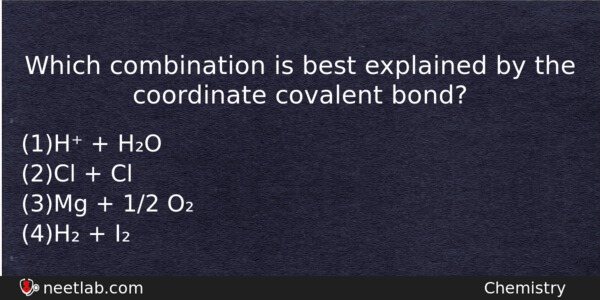
Which combination is best explained by the coordinate covalent bond?
Options
(a) H⁺ + H₂O
(b) Cl + Cl
(c) Mg + 1/2 O₂
(d) H₂ + I₂
Correct Answer:
H⁺ + H₂O
Explanation:
No explanation available. Be the first to write the explanation for this question by commenting below.
Related Questions: - Which electronic configuration of an element has abnormally high difference
- Glycerol reacts with KHSO₄ to form
- The rapid change of pH near the stoichiometric point of an acid-base titration
- The most basic amine among the following is
- At 400K sodium phenoxide reacts with CO₂ to produce
Question Type: Memory
(964)
Difficulty Level: Easy
(1008)
Topics: Chemical Bonding and Molecular Structure
(86)
Subject: Chemistry
(2512)
Important MCQs Based on Medical Entrance Examinations To Improve Your NEET Score
- Which electronic configuration of an element has abnormally high difference
- Glycerol reacts with KHSO₄ to form
- The rapid change of pH near the stoichiometric point of an acid-base titration
- The most basic amine among the following is
- At 400K sodium phenoxide reacts with CO₂ to produce
Question Type: Memory (964)
Difficulty Level: Easy (1008)
Topics: Chemical Bonding and Molecular Structure (86)
Subject: Chemistry (2512)
Important MCQs Based on Medical Entrance Examinations To Improve Your NEET Score
18000+ students are using NEETLab to improve their score. What about you?
Solve Previous Year MCQs, Mock Tests, Topicwise Practice Tests, Identify Weak Topics, Formula Flash cards and much more is available in NEETLab Android App to improve your NEET score.

Share this page with your friends
Explanation
In H2O , O will donate electron pair to H+ to form H3O