| ⇦ | 
| ⇨ |
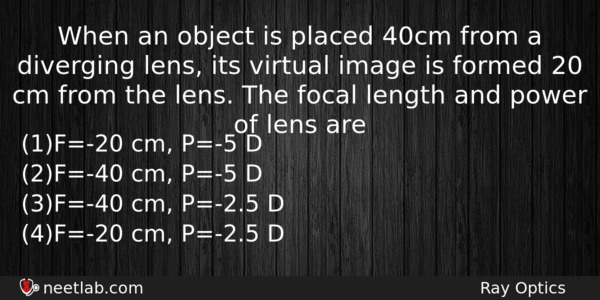
When an object is placed 40cm from a diverging lens, its virtual image is formed 20 cm from the lens. The focal length and power of lens are
Options
(a) F=-20 cm, P=-5 D
(b) F=-40 cm, P=-5 D
(c) F=-40 cm, P=-2.5 D
(d) F=-20 cm, P=-2.5 D
Correct Answer:
F=-40 cm, P=-2.5 D
Explanation:
We have, 1 / f = (1/v) – (1/u) ⇒ 1 / f = (1/-20) – (-1/40) = (-1 + 1) / 40 = 1 / 40
f = – 40 cm
Power of the lens, P = – (200 / 0.40) = – 2.5 D
Related Questions: - Find out the e.m.f. produced when the current changes from 0 to 1 A in 10 sec.
- Photon of frequency ν has a momentum associated with it. If c is the velocity
- A body of mass 0.25 kg is projected with muzzle velocity 100 m/s from a tank
- The de-Broglie wavelength of an electron having 80 eV of energy is nearly
- A long solenoid has 500 turns. When a current of 2 ampere is passed through it
Topics: Ray Optics
(94)
Subject: Physics
(2479)
Important MCQs Based on Medical Entrance Examinations To Improve Your NEET Score
- Find out the e.m.f. produced when the current changes from 0 to 1 A in 10 sec.
- Photon of frequency ν has a momentum associated with it. If c is the velocity
- A body of mass 0.25 kg is projected with muzzle velocity 100 m/s from a tank
- The de-Broglie wavelength of an electron having 80 eV of energy is nearly
- A long solenoid has 500 turns. When a current of 2 ampere is passed through it
Topics: Ray Optics (94)
Subject: Physics (2479)
Important MCQs Based on Medical Entrance Examinations To Improve Your NEET Score
18000+ students are using NEETLab to improve their score. What about you?
Solve Previous Year MCQs, Mock Tests, Topicwise Practice Tests, Identify Weak Topics, Formula Flash cards and much more is available in NEETLab Android App to improve your NEET score.

Share this page with your friends
Leave a Reply