| ⇦ | 
| ⇨ |
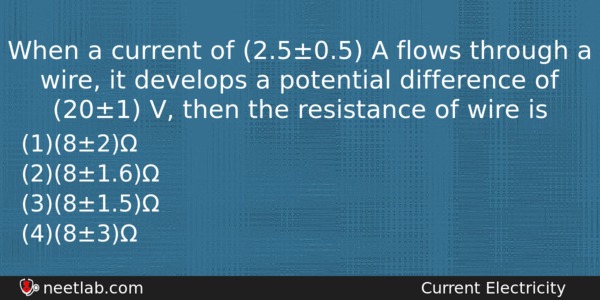
When a current of (2.5±0.5) A flows through a wire, it develops a potential difference of (20±1) V, then the resistance of wire is
Options
(a) (8±2)Ω
(b) (8±1.6)Ω
(c) (8±1.5)Ω
(d) (8±3)Ω
Correct Answer:
(8±2)Ω
Explanation:
No explanation available. Be the first to write the explanation for this question by commenting below.
Related Questions: - A dip needle vibrates in a vertical plane perpendicular to magnetic meridian. The time
- Length of a conductor is 50 cm radius of cross section 0.1 cm and resistivity
- The pair of quantities having same dimensions is
- An engine pumps water continuously through a hose. Water leaves the hose
- If light emitted from sodium bulb is passed through sodium vapour,
Topics: Current Electricity
(136)
Subject: Physics
(2479)
Important MCQs Based on Medical Entrance Examinations To Improve Your NEET Score
- A dip needle vibrates in a vertical plane perpendicular to magnetic meridian. The time
- Length of a conductor is 50 cm radius of cross section 0.1 cm and resistivity
- The pair of quantities having same dimensions is
- An engine pumps water continuously through a hose. Water leaves the hose
- If light emitted from sodium bulb is passed through sodium vapour,
Topics: Current Electricity (136)
Subject: Physics (2479)
Important MCQs Based on Medical Entrance Examinations To Improve Your NEET Score
18000+ students are using NEETLab to improve their score. What about you?
Solve Previous Year MCQs, Mock Tests, Topicwise Practice Tests, Identify Weak Topics, Formula Flash cards and much more is available in NEETLab Android App to improve your NEET score.

Share this page with your friends
R=V/I
R=20/2.5
R= 8 ohm
Now,
∆ R/R=∆ V/V+∆I/I
=1/20 +0.5/2.5
= 1/4
Therefore,
∆ R÷R=1÷4
∆ R=1÷4×R
∆R=1÷4×8
∆R=2
Therefore,
Resistance with error limits=R+ – ∆R
=(8+ – 2)ohm