| ⇦ | 
| ⇨ |
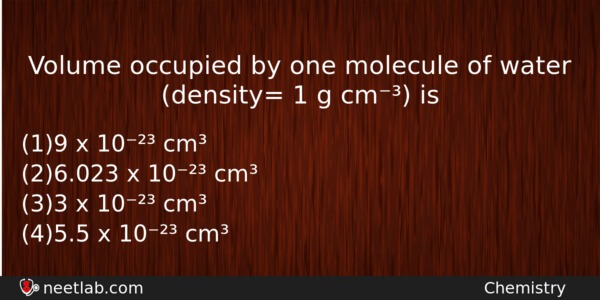
Volume occupied by one molecule of water (density= 1 g cm⁻³) is
Options
(a) 9 x 10⁻²³ cm³
(b) 6.023 x 10⁻²³ cm³
(c) 3 x 10⁻²³ cm³
(d) 5.5 x 10⁻²³ cm³
Correct Answer:
3 x 10⁻²³ cm³
Explanation:
density = mass/volume
volume=mass/density
=1 gram/ 1 gram cm⁻³ = 1 cm³
1 g water= 1/18 moles of water
(at wt of H *2 + at wt of oxygen = 18)
volume occupied by 1 molecules of water = (18 / (6.02 x 10²³)) cm³
= 3 x 10⁻²³ cm³
Related Questions: - Which of the following statements about H₃BO₃ is not correct
- If diazotisation of aniline is carried out at 30⁰ C,the main organic product
- In a face-centered cubic lattice, a unit cell is shared equally by how many unit
- K₄[Fe(CN)₆] is a
- Allergy is the state in which a person experiences
Question Type: Memory
(964)
Difficulty Level: Easy
(1008)
Topics: Basic Concepts of Chemistry
(94)
Subject: Chemistry
(2512)
Important MCQs Based on Medical Entrance Examinations To Improve Your NEET Score
- Which of the following statements about H₃BO₃ is not correct
- If diazotisation of aniline is carried out at 30⁰ C,the main organic product
- In a face-centered cubic lattice, a unit cell is shared equally by how many unit
- K₄[Fe(CN)₆] is a
- Allergy is the state in which a person experiences
Question Type: Memory (964)
Difficulty Level: Easy (1008)
Topics: Basic Concepts of Chemistry (94)
Subject: Chemistry (2512)
Important MCQs Based on Medical Entrance Examinations To Improve Your NEET Score
18000+ students are using NEETLab to improve their score. What about you?
Solve Previous Year MCQs, Mock Tests, Topicwise Practice Tests, Identify Weak Topics, Formula Flash cards and much more is available in NEETLab Android App to improve your NEET score.

Share this page with your friends
Leave a Reply