| ⇦ | 
| ⇨ |
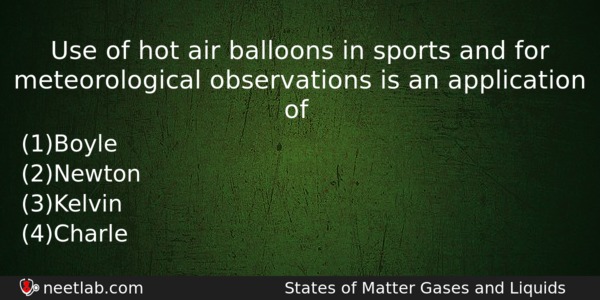
Use of hot air balloons in sports and for meteorological observations is an application of
Options
(a) Boyle’s law
(b) Newton’s law
(c) Kelvin’s law
(d) Charle’s law
Correct Answer:
Charle’s law
Explanation:
The Charles’s law is the use of hot air balloons in sports and for meteorological observations gas expands on heating. Since the mass of gas sample is constant, the larger volume at higher temperature will have lower mass per unit volume and therefore lower density. Thus hot air is less dense than cold air. This causes a hot air balloon to rise by displacing cool air of the atmosphere.
Related Questions: - Which among the following gas will greatly deviate from Henry’s law in water
- Which is a metalloid
- Tetraethyl lead is used as
- Dihedral angle in staggered form of ethane is
- In Lassaigne’s test a violet colour obtained indicates the presence of
Topics: States of Matter Gases and Liquids
(80)
Subject: Chemistry
(2512)
Important MCQs Based on Medical Entrance Examinations To Improve Your NEET Score
- Which among the following gas will greatly deviate from Henry’s law in water
- Which is a metalloid
- Tetraethyl lead is used as
- Dihedral angle in staggered form of ethane is
- In Lassaigne’s test a violet colour obtained indicates the presence of
Topics: States of Matter Gases and Liquids (80)
Subject: Chemistry (2512)
Important MCQs Based on Medical Entrance Examinations To Improve Your NEET Score
18000+ students are using NEETLab to improve their score. What about you?
Solve Previous Year MCQs, Mock Tests, Topicwise Practice Tests, Identify Weak Topics, Formula Flash cards and much more is available in NEETLab Android App to improve your NEET score.

Share this page with your friends
The use of hot air balloons in sports and for meteorological observations is an interesting application of Charle’s law. According to Charle’s law, gases expand on heating and hot air is less dense than cool air. This causes a hot air balloon to rise by displacing the cooler air of the atmosphere.