| ⇦ | 
| ⇨ |
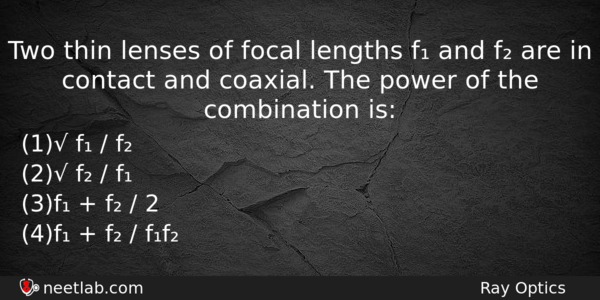
Two thin lenses of focal lengths f₁ and f₂ are in contact and coaxial. The power of the combination is:
Options
(a) √ f₁ / f₂
(b) √ f₂ / f₁
(c) f₁ + f₂ / 2
(d) f₁ + f₂ / f₁f₂
Correct Answer:
f₁ + f₂ / f₁f₂
Explanation:
The focal length of the combination
1/f = 1/f₁ + 1/f₂
Power of the combinations,
P = f₁ + f₂ / f₁ f₂ ( P = 1 / f )
Related Questions: - The coefficient of mutual inductance of two coils is 6 mH. If the current flowing
- Watt hour mter measures
- Carbon,silicon and germanium have four valence electrons each. At room temperature
- 300j work is done in sliding a 2kg block up an inclined plane of height 10m
- If the cold junction of a thermo-couple is kept at 0⁰C and the hot junction is kept
Topics: Ray Optics
(94)
Subject: Physics
(2479)
Important MCQs Based on Medical Entrance Examinations To Improve Your NEET Score
- The coefficient of mutual inductance of two coils is 6 mH. If the current flowing
- Watt hour mter measures
- Carbon,silicon and germanium have four valence electrons each. At room temperature
- 300j work is done in sliding a 2kg block up an inclined plane of height 10m
- If the cold junction of a thermo-couple is kept at 0⁰C and the hot junction is kept
Topics: Ray Optics (94)
Subject: Physics (2479)
Important MCQs Based on Medical Entrance Examinations To Improve Your NEET Score
18000+ students are using NEETLab to improve their score. What about you?
Solve Previous Year MCQs, Mock Tests, Topicwise Practice Tests, Identify Weak Topics, Formula Flash cards and much more is available in NEETLab Android App to improve your NEET score.

Share this page with your friends
Leave a Reply