| ⇦ | 
| ⇨ |
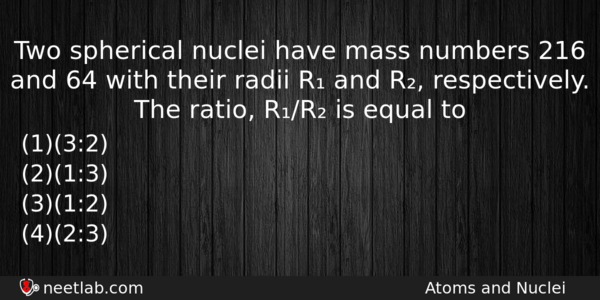
Two spherical nuclei have mass numbers 216 and 64 with their radii R₁ and R₂, respectively. The ratio, R₁/R₂ is equal to
Options
(a) (3:2)
(b) (1:3)
(c) (1:2)
(d) (2:3)
Correct Answer:
(3:2)
Explanation:
Radius of nuclei having mass number A is determined as
R = R₀ A¹/³ (where R₀ = constant)
where, R₀ = 1.2 x 10⁻¹⁵ m
This implies, R₁/R₂ = (A₁/A₂)¹/³ = (216/64)¹/³ = 6/4
R₁:R₂ = 3:2
Related Questions: - The work done in which of the following processes is equal to the change in internal energy
- Astigmatism is corrected by using
- A uranium nucleus ₉₂ U ²³⁸ emits an α-particle and a β-particle in succession.
- An artificial satellite is revolving round the earth in a circular orbit. Its velocity
- If the binding energy of the electron in a hydrogen atom is 13.6 eV, the energy
Topics: Atoms and Nuclei
(136)
Subject: Physics
(2479)
Important MCQs Based on Medical Entrance Examinations To Improve Your NEET Score
- The work done in which of the following processes is equal to the change in internal energy
- Astigmatism is corrected by using
- A uranium nucleus ₉₂ U ²³⁸ emits an α-particle and a β-particle in succession.
- An artificial satellite is revolving round the earth in a circular orbit. Its velocity
- If the binding energy of the electron in a hydrogen atom is 13.6 eV, the energy
Topics: Atoms and Nuclei (136)
Subject: Physics (2479)
Important MCQs Based on Medical Entrance Examinations To Improve Your NEET Score
18000+ students are using NEETLab to improve their score. What about you?
Solve Previous Year MCQs, Mock Tests, Topicwise Practice Tests, Identify Weak Topics, Formula Flash cards and much more is available in NEETLab Android App to improve your NEET score.

Share this page with your friends
R=R°A^1/3. (R°=constant
R1÷R2 =(A1÷A2)^1/3
=(216÷64)^1/3
=6÷4.
=> R1:R2 = 3:2