| ⇦ | 
| ⇨ |
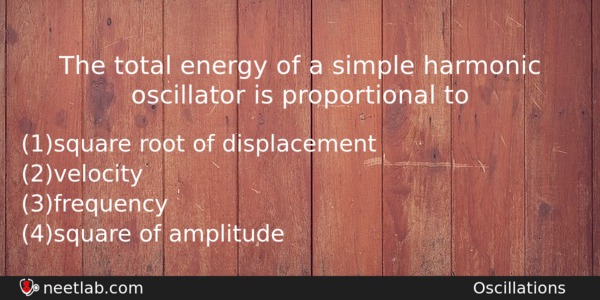
The total energy of a simple harmonic oscillator is proportional to
Options
(a) square root of displacement
(b) velocity
(c) frequency
(d) square of amplitude
Correct Answer:
square of amplitude
Explanation:
The total energy of a simple harmonic oscillator
(1/2). mω²A² (or) (1/2). kA²
Therefore it is proportional to the square of the amplitude.
Related Questions: - A polished metal plate has a rough and black-spot. It is heated to 1400 K
- The value of Poisson’s ratio lies between
- A boy is trying to start a fire by focusing sunlight on a piece of paper using
- In a compound microscope, the focal length of the objective is 2.5 cm and of eye lens
- Which of the following quantities has units but not dimensions
Topics: Oscillations
(58)
Subject: Physics
(2479)
Important MCQs Based on Medical Entrance Examinations To Improve Your NEET Score
- A polished metal plate has a rough and black-spot. It is heated to 1400 K
- The value of Poisson’s ratio lies between
- A boy is trying to start a fire by focusing sunlight on a piece of paper using
- In a compound microscope, the focal length of the objective is 2.5 cm and of eye lens
- Which of the following quantities has units but not dimensions
Topics: Oscillations (58)
Subject: Physics (2479)
Important MCQs Based on Medical Entrance Examinations To Improve Your NEET Score
18000+ students are using NEETLab to improve their score. What about you?
Solve Previous Year MCQs, Mock Tests, Topicwise Practice Tests, Identify Weak Topics, Formula Flash cards and much more is available in NEETLab Android App to improve your NEET score.

Share this page with your friends
Leave a Reply