| ⇦ | 
| ⇨ |
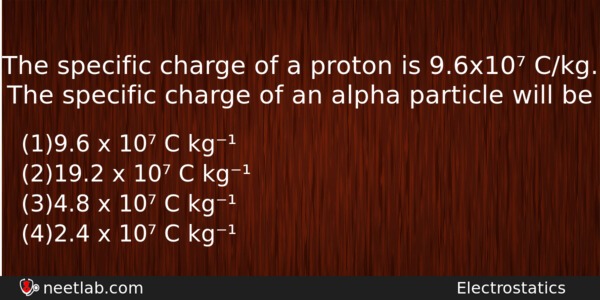
The specific charge of a proton is 9.6×10⁷ C/kg. The specific charge of an alpha particle will be
Options
(a) 9.6 x 10⁷ C kg⁻¹
(b) 19.2 x 10⁷ C kg⁻¹
(c) 4.8 x 10⁷ C kg⁻¹
(d) 2.4 x 10⁷ C kg⁻¹
Correct Answer:
4.8 x 10⁷ C kg⁻¹
Explanation:
For proton, specific charge = e / m = 9.6 × 10⁷ C kg⁻¹
For alpha particle, specific charge = 2e / 4m = 1e / 2m
= (1/2) × 9.6 × 10⁷ = 4.8 × 10⁷ C kg⁻¹
Related Questions: - A compass needle which is allowed to move in a horizontal plane
- The photoelectric threshold frequency of a metal is ν. When light of frequency 4ν
- A particle is released from rest from a tower of height h, i.e,t₁ : t₂ : t₃ is
- Angular momentum of the particle rotating with a central force is constant due to
- Two electrons are separated by a distance of 1Å. What is the coulomb force between them?
Topics: Electrostatics
(146)
Subject: Physics
(2479)
Important MCQs Based on Medical Entrance Examinations To Improve Your NEET Score
- A compass needle which is allowed to move in a horizontal plane
- The photoelectric threshold frequency of a metal is ν. When light of frequency 4ν
- A particle is released from rest from a tower of height h, i.e,t₁ : t₂ : t₃ is
- Angular momentum of the particle rotating with a central force is constant due to
- Two electrons are separated by a distance of 1Å. What is the coulomb force between them?
Topics: Electrostatics (146)
Subject: Physics (2479)
Important MCQs Based on Medical Entrance Examinations To Improve Your NEET Score
18000+ students are using NEETLab to improve their score. What about you?
Solve Previous Year MCQs, Mock Tests, Topicwise Practice Tests, Identify Weak Topics, Formula Flash cards and much more is available in NEETLab Android App to improve your NEET score.

Share this page with your friends
Leave a Reply