| ⇦ | 
| ⇨ |
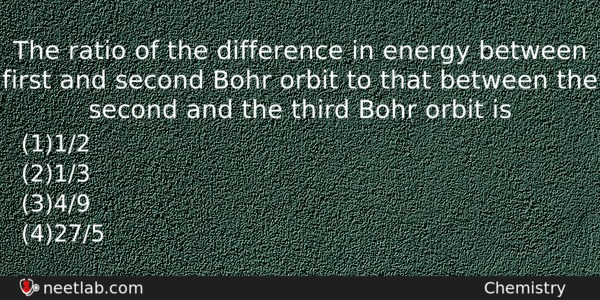
The ratio of the difference in energy between first and second Bohr orbit to that between the second and the third Bohr orbit is
Options
(a) 1/2
(b) 1/3
(c) 4/9
(d) 27/5
Correct Answer:
27/5
Explanation:
E₁ – E₂ = 1312 x Z²(1/1² – 1/2²)
= 1312 x Z²(3/4)
E₂ – E₃ = 1312 x Z²(1/2² – 1/3²)
= 1312 x Z²(5/36)
From eqs. (i) and (ii)
E₁ – E₂ / E₂ – E₃ = 3 x 26 / 4 x 5 = 27/5
Related Questions: - A bivalent metal has the equivalent weight of 12. The molecular weight
- By passing air over red hot coke the gas obtained is
- Which of the following will show a negative deviation from Raoult’s law
- The absorption of hydrogen by palladium is called
- Which contains both polar and non-polar covalent bonds?
Question Type: Memory
(964)
Difficulty Level: Easy
(1008)
Topics: Structure of Atom
(90)
Subject: Chemistry
(2512)
Important MCQs Based on Medical Entrance Examinations To Improve Your NEET Score
- A bivalent metal has the equivalent weight of 12. The molecular weight
- By passing air over red hot coke the gas obtained is
- Which of the following will show a negative deviation from Raoult’s law
- The absorption of hydrogen by palladium is called
- Which contains both polar and non-polar covalent bonds?
Question Type: Memory (964)
Difficulty Level: Easy (1008)
Topics: Structure of Atom (90)
Subject: Chemistry (2512)
Important MCQs Based on Medical Entrance Examinations To Improve Your NEET Score
18000+ students are using NEETLab to improve their score. What about you?
Solve Previous Year MCQs, Mock Tests, Topicwise Practice Tests, Identify Weak Topics, Formula Flash cards and much more is available in NEETLab Android App to improve your NEET score.

Share this page with your friends
Leave a Reply