| ⇦ | 
| ⇨ |
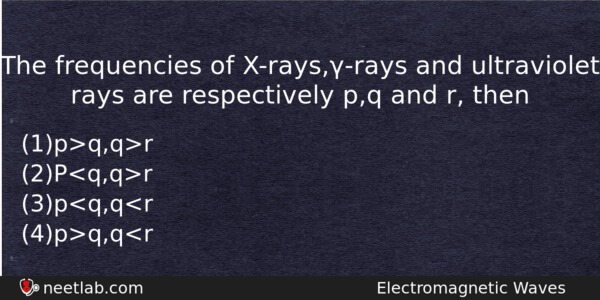
The frequencies of X-rays,γ-rays and ultraviolet rays are respectively p,q and r, then
Options
(a) p greater than q,q greater than r
(b) p less than q,q greater than r
(c) p less than q,q less than r
(d) p greater than q,q less than r
Correct Answer:
p less than q,q greater than r
Explanation:
No explanation available. Be the first to write the explanation for this question by commenting below.
Related Questions: - A magnetic needle suspended parallel to a magnetic field requires √3J of work
- For photoelectric emission from certain metal the cut-off frequency is v
- When we hear a sound, we can identify its source from
- The minimum wavelength of X-rays emitted by X-ray tube is 0.4125Å
- A solid which is transparent to visible light and whose conductivity increases
Topics: Electromagnetic Waves
(28)
Subject: Physics
(2479)
Important MCQs Based on Medical Entrance Examinations To Improve Your NEET Score
- A magnetic needle suspended parallel to a magnetic field requires √3J of work
- For photoelectric emission from certain metal the cut-off frequency is v
- When we hear a sound, we can identify its source from
- The minimum wavelength of X-rays emitted by X-ray tube is 0.4125Å
- A solid which is transparent to visible light and whose conductivity increases
Topics: Electromagnetic Waves (28)
Subject: Physics (2479)
Important MCQs Based on Medical Entrance Examinations To Improve Your NEET Score
18000+ students are using NEETLab to improve their score. What about you?
Solve Previous Year MCQs, Mock Tests, Topicwise Practice Tests, Identify Weak Topics, Formula Flash cards and much more is available in NEETLab Android App to improve your NEET score.

Share this page with your friends
frequency of uv rays(r)=10^16 Hz to 10^17 Hz
frequency of x-rays(p)=10^18 Hz to 10^20 Hz
frequency of gamma-rays(q)=10^18 Hz to 10^22 Hz
therefore, p is less than q and q is greater than r.