| ⇦ | 
| ⇨ |
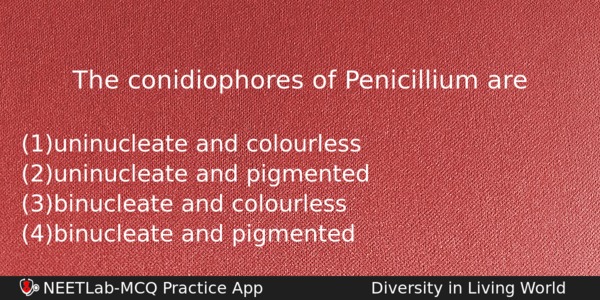
The conidiophores of Penicillium are
Options
(a) uninucleate and colourless
(b) uninucleate and pigmented
(c) binucleate and colourless
(d) binucleate and pigmented
Correct Answer:
uninucleate and pigmented
Explanation:
Species of Penicillium are recognised by their dense brush-like spore-bearing structures known as conidiophores. These are simple or branched, uninucleate & pigmented and are terminated by clusters of flask shaped phialides. The spores(conidia) are produced in dry chains from the tips of the phialides, with the youngest spore at the base of the chain.
Related Questions: - Static concept of species was put forward by
- The zone of atmosphere in which the ozone layer is:
- Which is not correct with respect to human kidney?
- The smallest segment of DNA which helps to detect the presence of a gene or a long
- Ciliated epithelium in vertebrates is present in
Topics: Diversity In Living World
(339)
Subject: Biology
(4253)
Important MCQs Based on Medical Entrance Examinations To Improve Your NEET Score
- Static concept of species was put forward by
- The zone of atmosphere in which the ozone layer is:
- Which is not correct with respect to human kidney?
- The smallest segment of DNA which helps to detect the presence of a gene or a long
- Ciliated epithelium in vertebrates is present in
Topics: Diversity In Living World (339)
Subject: Biology (4253)
Important MCQs Based on Medical Entrance Examinations To Improve Your NEET Score
18000+ students are using NEETLab to improve their score. What about you?
Solve Previous Year MCQs, Mock Tests, Topicwise Practice Tests, Identify Weak Topics, Formula Flash cards and much more is available in NEETLab Android App to improve your NEET score.

Share this page with your friends
Leave a Reply