| ⇦ | 
| ⇨ |
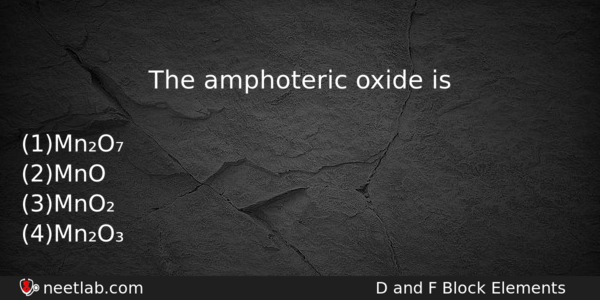
The amphoteric oxide is
Options
(a) Mn₂O₇
(b) MnO
(c) MnO₂
(d) Mn₂O₃
Correct Answer:
MnO₂
Explanation:
(i) Oxides in lower oxidation states are basic in nature. (ii) Oxides in intermediate oxidation states are amphoteric.(iii) The oxides of higher oxidation states are acidic in nature. Mno, Mn₂O₃ – Basic, MnO₂ – Amphoteric, MnO₃, Mn₂O₇ – unstable Acidic.
Related Questions: - Fischer-Tropsch process is used in the manufacture of
- Two possible stereo-structures of CH₃CHOHCOOH, Which are optically active are called
- If a compound, on analysis was found to contain C=18.5% ,H=1.55%, Cl=55.04%
- Which of the following is an amphoteric oxide
- Of the following complex ions one exhibits isomerism.That one is
Topics: D and F Block Elements
(91)
Subject: Chemistry
(2512)
Important MCQs Based on Medical Entrance Examinations To Improve Your NEET Score
- Fischer-Tropsch process is used in the manufacture of
- Two possible stereo-structures of CH₃CHOHCOOH, Which are optically active are called
- If a compound, on analysis was found to contain C=18.5% ,H=1.55%, Cl=55.04%
- Which of the following is an amphoteric oxide
- Of the following complex ions one exhibits isomerism.That one is
Topics: D and F Block Elements (91)
Subject: Chemistry (2512)
Important MCQs Based on Medical Entrance Examinations To Improve Your NEET Score
18000+ students are using NEETLab to improve their score. What about you?
Solve Previous Year MCQs, Mock Tests, Topicwise Practice Tests, Identify Weak Topics, Formula Flash cards and much more is available in NEETLab Android App to improve your NEET score.

Share this page with your friends
Leave a Reply