| ⇦ | 
| ⇨ |
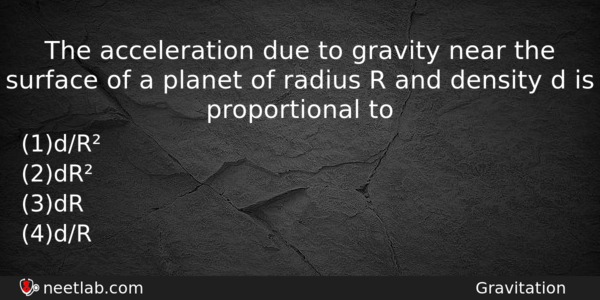
The acceleration due to gravity near the surface of a planet of radius R and density d is proportional to
Options
(a) d/R²
(b) dR²
(c) dR
(d) d/R
Correct Answer:
dR
Explanation:
g=GM/R²
(M=Mass of the earth); (R=Distance of body from centre of earth)
g=G Volume x density / R²
Volume of the sphere=4/3 πR³
Therefore, g=G.4/3 πR³.d / R²
g=G 4/3 πRd
g=4πG/3.dR
g is proportional to dR
Related Questions: - Two particles which are initially at rest, move towards each other
- A small object of uniform density rolls up a curved surface with an initial velocity
- The difference in the variation of resistance with temperature in a metal
- A step down transformer is used on a 1000 V line to deliver 20 A at 120 V
- Two stones of masses m and 2m are whirled in horizontal circles, the heavier one
Topics: Gravitation
(63)
Subject: Physics
(2479)
Important MCQs Based on Medical Entrance Examinations To Improve Your NEET Score
- Two particles which are initially at rest, move towards each other
- A small object of uniform density rolls up a curved surface with an initial velocity
- The difference in the variation of resistance with temperature in a metal
- A step down transformer is used on a 1000 V line to deliver 20 A at 120 V
- Two stones of masses m and 2m are whirled in horizontal circles, the heavier one
Topics: Gravitation (63)
Subject: Physics (2479)
Important MCQs Based on Medical Entrance Examinations To Improve Your NEET Score
18000+ students are using NEETLab to improve their score. What about you?
Solve Previous Year MCQs, Mock Tests, Topicwise Practice Tests, Identify Weak Topics, Formula Flash cards and much more is available in NEETLab Android App to improve your NEET score.

Share this page with your friends
Leave a Reply