| ⇦ | 
| ⇨ |
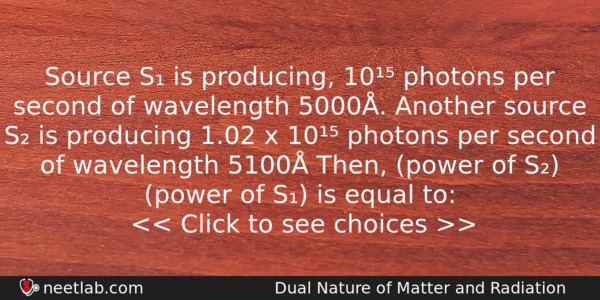
Source S₁ is producing, 10¹⁵ photons per second of wavelength 5000Å. Another source S₂ is producing 1.02 x 10¹⁵ photons per second of wavelength 5100Å Then, (power of S₂) (power of S₁) is equal to:
Options
(a) 1
(b) 1.02
(c) 1.04
(d) 0.98
Correct Answer:
1
Explanation:
energy emitted/sec by S₁, P₁ = n₁ hc / λ₁
energy emitted/sec by S₂, P₂ = n₂ hc / λ₂
P₂ / P₁ = n₂ / n₁ . λ₁ / λ₂
= 1.02 x 10¹⁵ / 10¹⁵ . 5000 / 5100 = 1.0
Related Questions: - A parallel beam of light of wavelength λ is incident normally on a narrow slit
- Two points are located at a distance of 10 m and 15 m from the source of oscillation
- The escape velocity of a body on an imaginary planet which is thrice the radius
- In a circuit, L,C and R are connected in series with an alternating voltage source
- The excitation potential of hydrogen atom in the first excited state is
Topics: Dual Nature of Matter and Radiation
(150)
Subject: Physics
(2479)
Important MCQs Based on Medical Entrance Examinations To Improve Your NEET Score
- A parallel beam of light of wavelength λ is incident normally on a narrow slit
- Two points are located at a distance of 10 m and 15 m from the source of oscillation
- The escape velocity of a body on an imaginary planet which is thrice the radius
- In a circuit, L,C and R are connected in series with an alternating voltage source
- The excitation potential of hydrogen atom in the first excited state is
Topics: Dual Nature of Matter and Radiation (150)
Subject: Physics (2479)
Important MCQs Based on Medical Entrance Examinations To Improve Your NEET Score
18000+ students are using NEETLab to improve their score. What about you?
Solve Previous Year MCQs, Mock Tests, Topicwise Practice Tests, Identify Weak Topics, Formula Flash cards and much more is available in NEETLab Android App to improve your NEET score.

Share this page with your friends
Leave a Reply