| ⇦ | 
| ⇨ |
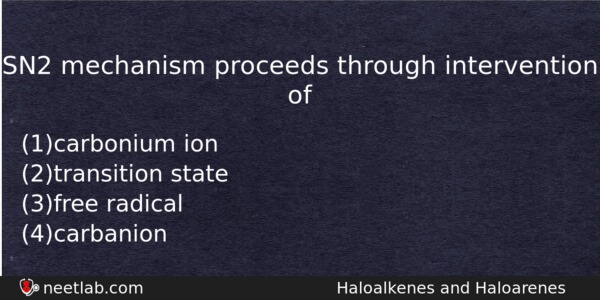
SN2 mechanism proceeds through intervention of
Options
(a) carbonium ion
(b) transition state
(c) free radical
(d) carbanion
Correct Answer:
transition state
Explanation:
S(N)2 mechanism proceeds through transition state. e.g. When the methyl chloride is attracked by OH⁻ strong nucleophile from the opposite side of the chlorine atom, a transition state (TS) results in which both OH and Cl are partially bonded to carbon atom.
Related Questions: - At 25⁰C the pH value of a solution is 6, then the solution is
- An organic compound containing C, H and O gave the following analysis
- In a cubic cell,the contribution of an atom at a face of the unit cell is
- A sample of CaCO₃ is 50% pure. On heating 1.12 L of CO₂ at STP is obtained
- Chlorination of toluene in the presence of light and heat followed by treatment
Topics: Haloalkenes and Haloarenes
(78)
Subject: Chemistry
(2512)
Important MCQs Based on Medical Entrance Examinations To Improve Your NEET Score
- At 25⁰C the pH value of a solution is 6, then the solution is
- An organic compound containing C, H and O gave the following analysis
- In a cubic cell,the contribution of an atom at a face of the unit cell is
- A sample of CaCO₃ is 50% pure. On heating 1.12 L of CO₂ at STP is obtained
- Chlorination of toluene in the presence of light and heat followed by treatment
Topics: Haloalkenes and Haloarenes (78)
Subject: Chemistry (2512)
Important MCQs Based on Medical Entrance Examinations To Improve Your NEET Score
18000+ students are using NEETLab to improve their score. What about you?
Solve Previous Year MCQs, Mock Tests, Topicwise Practice Tests, Identify Weak Topics, Formula Flash cards and much more is available in NEETLab Android App to improve your NEET score.

Share this page with your friends
Leave a Reply