| ⇦ | 
| ⇨ |
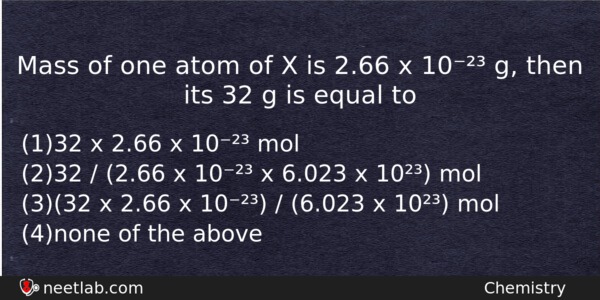
Mass of one atom of X is 2.66 x 10⁻²³ g, then its 32 g is equal to
Options
(a) 32 x 2.66 x 10⁻²³ mol
(b) 32 / (2.66 x 10⁻²³ x 6.023 x 10²³) mol
(c) (32 x 2.66 x 10⁻²³) / (6.023 x 10²³) mol
(d) none of the above
Correct Answer:
32 / (2.66 x 10⁻²³ x 6.023 x 10²³) mol
Explanation:
Mass of one atom = 2.66 x 10⁻²³
Atomic Mass =2.66 x 10⁻²³ x 6.02 x 10²³ g mol⁻¹
No. Moles in 32 g = 32 / Atomic Mass
Related Questions: - Treatment of cyclopentanone with methyl lithium gives which of the following species
- Which of the following is a buffer solution?
- Which of the following acts as both reducing and oxidising agent
- Excess nitrate in drinking water can cause
- The catalyst used in Ziegler process for polythylene manufacture
Question Type: Memory
(964)
Difficulty Level: Easy
(1008)
Topics: Basic Concepts of Chemistry
(94)
Subject: Chemistry
(2512)
Important MCQs Based on Medical Entrance Examinations To Improve Your NEET Score
- Treatment of cyclopentanone with methyl lithium gives which of the following species
- Which of the following is a buffer solution?
- Which of the following acts as both reducing and oxidising agent
- Excess nitrate in drinking water can cause
- The catalyst used in Ziegler process for polythylene manufacture
Question Type: Memory (964)
Difficulty Level: Easy (1008)
Topics: Basic Concepts of Chemistry (94)
Subject: Chemistry (2512)
Important MCQs Based on Medical Entrance Examinations To Improve Your NEET Score
18000+ students are using NEETLab to improve their score. What about you?
Solve Previous Year MCQs, Mock Tests, Topicwise Practice Tests, Identify Weak Topics, Formula Flash cards and much more is available in NEETLab Android App to improve your NEET score.

Share this page with your friends
Leave a Reply