| ⇦ | 
| ⇨ |
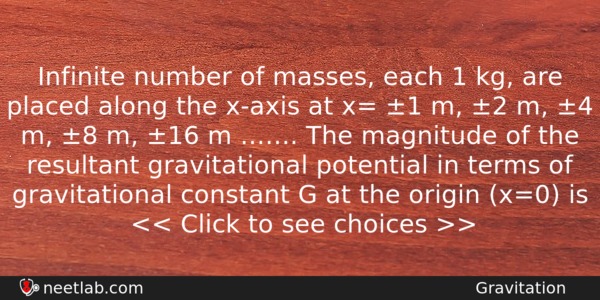
Infinite number of masses, each 1 kg, are placed along the x-axis at x= ±1 m, ±2 m, ±4 m, ±8 m, ±16 m ……. The magnitude of the resultant gravitational potential in terms of gravitational constant G at the origin (x=0) is
Options
(a) G
(b) 2G
(c) 4G
(d) 8G
Correct Answer:
4G
Explanation:
No explanation available. Be the first to write the explanation for this question by commenting below.
Related Questions: - A wire having resistance 12Ω is bent in the form of an equilateral triangle.
- A person can see clearly objects only when they lie between 50 cm and 400 cm from
- Current in a coil changes from 4 A to zero in 0.1 second and the emf induced is 100V
- When ₃Li⁷ nuclei are bombarded by protons, and the resultant nuclei are ₄Be⁸,
- The Boolean expression P+ P ̅ Q, where P and Q are the inputs of the logic
Topics: Gravitation
(63)
Subject: Physics
(2479)
Important MCQs Based on Medical Entrance Examinations To Improve Your NEET Score
- A wire having resistance 12Ω is bent in the form of an equilateral triangle.
- A person can see clearly objects only when they lie between 50 cm and 400 cm from
- Current in a coil changes from 4 A to zero in 0.1 second and the emf induced is 100V
- When ₃Li⁷ nuclei are bombarded by protons, and the resultant nuclei are ₄Be⁸,
- The Boolean expression P+ P ̅ Q, where P and Q are the inputs of the logic
Topics: Gravitation (63)
Subject: Physics (2479)
Important MCQs Based on Medical Entrance Examinations To Improve Your NEET Score
18000+ students are using NEETLab to improve their score. What about you?
Solve Previous Year MCQs, Mock Tests, Topicwise Practice Tests, Identify Weak Topics, Formula Flash cards and much more is available in NEETLab Android App to improve your NEET score.

Share this page with your friends
Leave a Reply