| ⇦ | 
| ⇨ |
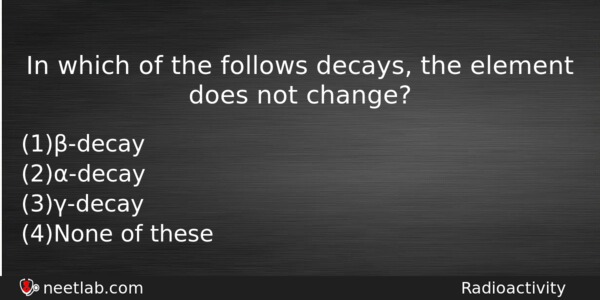
In which of the follows decays, the element does not change?
Options
(a) β-decay
(b) α-decay
(c) γ-decay
(d) None of these
Correct Answer:
γ-decay
Explanation:
No explanation available. Be the first to write the explanation for this question by commenting below.
Related Questions: - The coefficient of friction between the tyres and the road is 0.25. The maximum speed
- A coin of mass m and radius r having moment of inertia I about the axis passes
- A 0.01 H inductor and √3 πΩ resistance are connected in series
- What is the wavelength of light for the least energetic photon emitted
- Find the maximum velocity with which a train can be moved on a circular track
Topics: Radioactivity
(83)
Subject: Physics
(2479)
Important MCQs Based on Medical Entrance Examinations To Improve Your NEET Score
- The coefficient of friction between the tyres and the road is 0.25. The maximum speed
- A coin of mass m and radius r having moment of inertia I about the axis passes
- A 0.01 H inductor and √3 πΩ resistance are connected in series
- What is the wavelength of light for the least energetic photon emitted
- Find the maximum velocity with which a train can be moved on a circular track
Topics: Radioactivity (83)
Subject: Physics (2479)
Important MCQs Based on Medical Entrance Examinations To Improve Your NEET Score
18000+ students are using NEETLab to improve their score. What about you?
Solve Previous Year MCQs, Mock Tests, Topicwise Practice Tests, Identify Weak Topics, Formula Flash cards and much more is available in NEETLab Android App to improve your NEET score.

Share this page with your friends
γ-decay has no charge and no mass. Element does not change by γ-decay.