| ⇦ | 
| ⇨ |
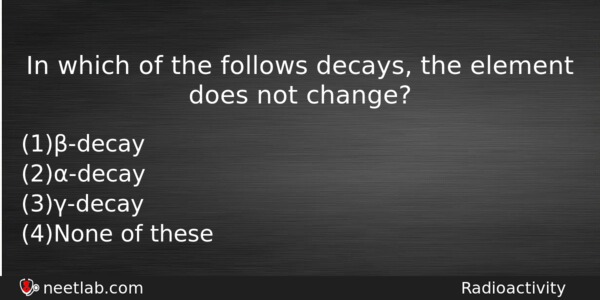
In which of the follows decays, the element does not change?
Options
(a) β-decay
(b) α-decay
(c) γ-decay
(d) None of these
Correct Answer:
γ-decay
Explanation:
No explanation available. Be the first to write the explanation for this question by commenting below.
Related Questions: - A capacitor is used to store 24 watt hour of energy at 1200 volt.
- A battery of emf 10 V and internal resistance 3 ohm is connected to a resistor.
- A particle is dropped from a building. It takes 4 sec for the particle to reach the ground
- A pure semiconductor behaves slightly as a conductor at
- The product of pressure and volume hve thesame units as the product of
Topics: Radioactivity
(83)
Subject: Physics
(2479)
Important MCQs Based on Medical Entrance Examinations To Improve Your NEET Score
- A capacitor is used to store 24 watt hour of energy at 1200 volt.
- A battery of emf 10 V and internal resistance 3 ohm is connected to a resistor.
- A particle is dropped from a building. It takes 4 sec for the particle to reach the ground
- A pure semiconductor behaves slightly as a conductor at
- The product of pressure and volume hve thesame units as the product of
Topics: Radioactivity (83)
Subject: Physics (2479)
Important MCQs Based on Medical Entrance Examinations To Improve Your NEET Score
18000+ students are using NEETLab to improve their score. What about you?
Solve Previous Year MCQs, Mock Tests, Topicwise Practice Tests, Identify Weak Topics, Formula Flash cards and much more is available in NEETLab Android App to improve your NEET score.

Share this page with your friends
γ-decay has no charge and no mass. Element does not change by γ-decay.