| ⇦ | 
| ⇨ |
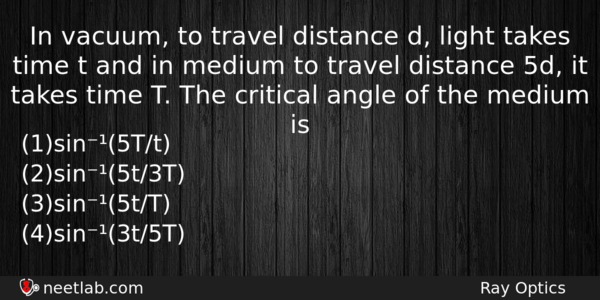
In vacuum, to travel distance d, light takes time t and in medium to travel distance 5d, it takes time T. The critical angle of the medium is
Options
(a) sin⁻¹(5T/t)
(b) sin⁻¹(5t/3T)
(c) sin⁻¹(5t/T)
(d) sin⁻¹(3t/5T)
Correct Answer:
sin⁻¹(5t/T)
Explanation:
In vacuum, c = d / t
In medium, v = 5d / T
As refractive index , μ = c / v = (d/t) / (5d/T) = T / 5t
Also, sin C = 1 / μ [If C is critical angle]
Therefore, C = sin⁻¹ [5t / T]
Related Questions: - A proton of mass 1.6×10⁻²⁷ kg goes round in a circular orbit of radius 0.10 m under
- Radius of a soap bubble is increased from R to 2R. Work done in this process
- A body of mass M hits normally a rigid wall with velocity V and bounces back
- A concave lens of focal length f forms an image which is 1/3 times the size
- The work of 146 kJ is performed in order to compress one kilo mole fo gas adiabatically
Topics: Ray Optics
(94)
Subject: Physics
(2479)
Important MCQs Based on Medical Entrance Examinations To Improve Your NEET Score
- A proton of mass 1.6×10⁻²⁷ kg goes round in a circular orbit of radius 0.10 m under
- Radius of a soap bubble is increased from R to 2R. Work done in this process
- A body of mass M hits normally a rigid wall with velocity V and bounces back
- A concave lens of focal length f forms an image which is 1/3 times the size
- The work of 146 kJ is performed in order to compress one kilo mole fo gas adiabatically
Topics: Ray Optics (94)
Subject: Physics (2479)
Important MCQs Based on Medical Entrance Examinations To Improve Your NEET Score
18000+ students are using NEETLab to improve their score. What about you?
Solve Previous Year MCQs, Mock Tests, Topicwise Practice Tests, Identify Weak Topics, Formula Flash cards and much more is available in NEETLab Android App to improve your NEET score.

Share this page with your friends
Leave a Reply