| ⇦ | 
| ⇨ |
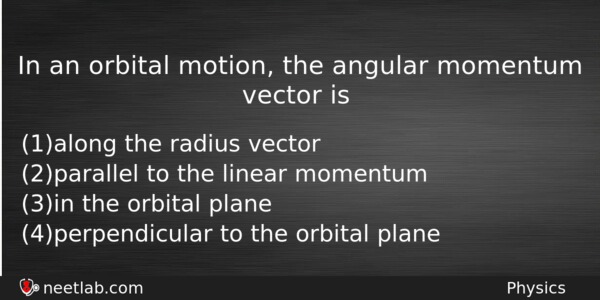
In an orbital motion, the angular momentum vector is
Options
(a) along the radius vector
(b) parallel to the linear momentum
(c) in the orbital plane
(d) perpendicular to the orbital plane
Correct Answer:
perpendicular to the orbital plane
Explanation:
No explanation available. Be the first to write the explanation for this question by commenting below.
Related Questions: - A ball moving with velocity 2 m/s collides head on with another stationary ball
- Point masses m₁ and m₂ are placed at the opposite ends of a rigid rod of length L,
- The polarising angle of glass is 57⁰. A ray of light which is incident at this angle
- The sun light reaches us as white and not as its components because
- 4.0 g of a gas occupies 22.4 litres at NTP. The specific heat capacity of the gas
Difficulty Level: Easy
(1008)
Topics: Motion in Plane
(93)
Subject: Physics
(2479)
Important MCQs Based on Medical Entrance Examinations To Improve Your NEET Score
- A ball moving with velocity 2 m/s collides head on with another stationary ball
- Point masses m₁ and m₂ are placed at the opposite ends of a rigid rod of length L,
- The polarising angle of glass is 57⁰. A ray of light which is incident at this angle
- The sun light reaches us as white and not as its components because
- 4.0 g of a gas occupies 22.4 litres at NTP. The specific heat capacity of the gas
Difficulty Level: Easy (1008)
Topics: Motion in Plane (93)
Subject: Physics (2479)
Important MCQs Based on Medical Entrance Examinations To Improve Your NEET Score
18000+ students are using NEETLab to improve their score. What about you?
Solve Previous Year MCQs, Mock Tests, Topicwise Practice Tests, Identify Weak Topics, Formula Flash cards and much more is available in NEETLab Android App to improve your NEET score.

Share this page with your friends
Leave a Reply