| ⇦ | 
| ⇨ |
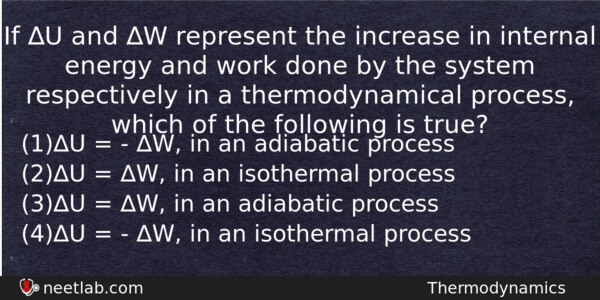
If ∆U and ∆W represent the increase in internal energy and work done by the system respectively in a thermodynamical process, which of the following is true?
Options
(a) ∆U = – ∆W, in an adiabatic process
(b) ∆U = ∆W, in an isothermal process
(c) ∆U = ∆W, in an adiabatic process
(d) ∆U = – ∆W, in an isothermal process
Correct Answer:
∆U = – ∆W, in an adiabatic process
Explanation:
BY first law of thermodynamics, ∆Q = ∆U + ∆W
In adiabatic process, ∆Q = 0 ∆U = – ∆W
In isothermal process, ∆U = 0 ∆Q = ∆W
Related Questions: - The energy required to charge a parallel plate condenser of plate separation d
- The instantaneous values of alternating current and voltages in a circuit are given as
- Equal charge q each are placed at the vertices AQ and B of an equilateral triangle
- If a full wave rectifier circuit is operating from 50 Hz mains, the fundamental
- The potential of a large liquid drop when eight liquid drops are combined is 20 V.
Topics: Thermodynamics
(179)
Subject: Physics
(2479)
Important MCQs Based on Medical Entrance Examinations To Improve Your NEET Score
- The energy required to charge a parallel plate condenser of plate separation d
- The instantaneous values of alternating current and voltages in a circuit are given as
- Equal charge q each are placed at the vertices AQ and B of an equilateral triangle
- If a full wave rectifier circuit is operating from 50 Hz mains, the fundamental
- The potential of a large liquid drop when eight liquid drops are combined is 20 V.
Topics: Thermodynamics (179)
Subject: Physics (2479)
Important MCQs Based on Medical Entrance Examinations To Improve Your NEET Score
18000+ students are using NEETLab to improve their score. What about you?
Solve Previous Year MCQs, Mock Tests, Topicwise Practice Tests, Identify Weak Topics, Formula Flash cards and much more is available in NEETLab Android App to improve your NEET score.

Share this page with your friends
Leave a Reply